


Last Updated August 11, 2026
The Science Behind Dr. Beasley’s Adaptive Buffer Technology™
Every product we retire teaches us something.
Sometimes it means the product wasn’t good enough, and sometimes it means we’ve found a better way to solve a problem an existing product already solved well. pH Neutralizer falls firmly into the second category: it worked exactly as intended, and earlier formulations were safe when used as directed. What changed wasn’t the problem — it was how much of the solution we could build into the cleaner itself.
For years, it occupied a unique place in our lineup. It wasn’t a cleaner. It wasn’t a protectant. It wasn’t even a maintenance product.
Its entire purpose was to stop a chemical reaction already in progress.
That might sound strange until you understand the chemistry of what happens once a cleaning product has finished doing its job.
Cleaning Doesn’t Stop When You Finish Rinsing or Wiping
Most people think cleaning ends when they rinse a surface, or in cases like interiors and leather, simply wipe it down.
From a chemical perspective, cleaning continues long after the visible dirt has been removed.
A wipe removes visible residue and excess product from the surface, but it doesn’t neutralize whatever thin film of chemistry remains in contact with the substrate. Unless that residue is diluted, rinsed, or actively deactivated, it’s still chemically active — just less visible.
Many cleaning formulations, particularly the acidic and alkaline cleaners this article focuses on, are built around a pH-driven reaction. Acidic wheel cleaners, typically formulated in the pH 1–3 range, dissolve the iron oxide that makes up the bulk of brake dust.i Alkaline cleaners work the opposite way, breaking down grease, oils, and organic soils through a reaction called saponification — the same chemistry that turns fat into soap.ii
That reaction is exactly what you want, while it’s happening.
The problem is that pH-driven reactions don’t have a built-in stopping point. A reaction proceeds as long as reactive ions and available substrate are both present — and once the contaminant is gone, the only substrate left is the surface itself.
Usually, that residual activity is negligible, and leftover cleaner doesn’t automatically keep damaging a surface. How much it matters depends on the surface, the chemistry involved, and how long contact lasts — which is exactly why some materials need more protection than others. Professional detailing isn’t built around “usually.” It’s built around minimizing exposure to conditions a surface wasn’t designed to tolerate.
This matters more on some surfaces than others. Many finished automotive leathers, for example, are tanned and finished to be chemically stable at a pH of roughly 4.5–5.5 — the range where its collagen fibers, tanning agents, and conditioning oils sit in balance.iii Push that same leather above neutral pH, and the fiber bundles start to swell and lose strength as the chemical bonds holding them together come apart.iv Because pH is measured on a logarithmic scale, small-sounding shifts are actually large ones: going from pH 5 to pH 7 is a hundredfold increase in alkalinity, and pH 9 is ten thousand times more alkaline than pH 5.v
That risk isn’t theoretical. We once took in a family SUV, a full-size three-row model, for a complete interior detail. The owners wanted the leather brought back to like-new condition and were confused when we pointed out damage that predated our work: uneven discoloration bleeding through the seats, and a distinct dark ring worn into the leather on the steering wheel. When we asked what they used to clean the leather at home, the answer was an ordinary household all-purpose cleaner — alkaline, and never intended for leather. Used once, it likely wouldn’t have done visible harm. Used routinely over months and years, it was a slow version of exactly the mechanism described above: each application pushed the leather’s surface chemistry further out of its stable range, and the damage compounded quietly until it surfaced as discoloration and worn-through color that no detailing service, ours included, could fully reverse. It’s a reminder that “safe enough for the kitchen counter” and “safe for leather” are two different chemical standards, not one.
Painted wheels, anodized finishes, and powder coating carry a parallel risk, and many wheel finishes cut that risk both ways. Aluminum is what chemists call amphoteric: its protective oxide layer can be stripped by strong acids and strong alkalis alike, which is why bare or anodized aluminum often calls for a narrower pH window than a painted surface.vi Clear coats and powder coatings have their own chemical tolerances, too — both can be etched or dulled by aggressive chemistry at either end of the pH scale, and once a coating is breached, whatever lies beneath, including bare aluminum, is exposed to further attack.vii
Professional detailing isn’t just knowing how to start a chemical reaction.
It’s knowing how to stop one, deliberately, before the surface becomes the reactant.
Why We Created pH Neutralizer
Years ago, while detailing heavily neglected wheels, I learned this lesson firsthand.
The brake dust was severe, heavy, baked-on, and embedded in the clear coat. The only practical solution was an acidic wheel cleaner strong enough to dissolve it.
The cleaner worked. The wheels looked new.
But afterward, I recognized that the acid had continued reacting longer than I’d intended. The contamination was gone, but the chemistry hadn’t fully disengaged from the surface.
That experience reframed how I thought about cleaning chemistry. The goal isn’t simply to remove contamination. It’s to remove contamination while leaving the surface’s chemical environment as close as possible to where it started.
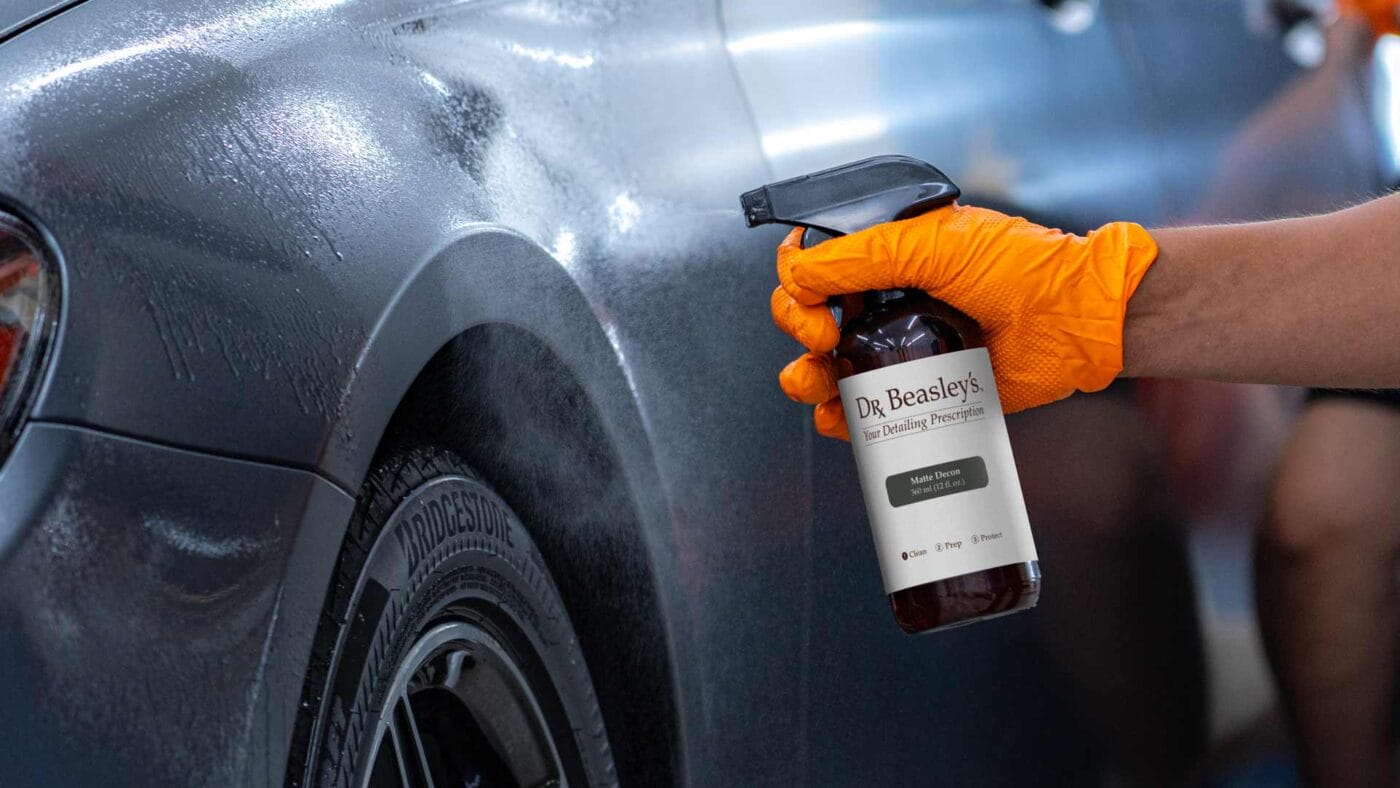
That’s why we developed pH Neutralizer, a separate step whose sole function was to interrupt residual chemical activity once cleaning was complete.
Then We Asked a Better Question
Eventually, we challenged our own solution.
Why should protecting the surface after cleaning require an entirely separate bottle? Our cleaners already worked safely as directed — but if an extra layer of control over residual reactivity was worth adding, shouldn’t that control live inside the cleaner itself, rather than as a second, optional step?
That question sent us back into the lab.
Introducing Dr. Beasley’s Adaptive Buffer Technology™ (ABT™)
Today, many of our acidic and alkaline cleaners incorporate what we call Dr. Beasley’s Adaptive Buffer Technology™ (ABT™).
Rather than relying on a separate neutralizing product after cleaning, Adaptive Buffer Technology™ integrates buffering chemistry directly into the formulation. In simple terms, a buffer pairs a weak acid with its conjugate base (or a weak base with its conjugate acid), so that any extra hydrogen or hydroxide ions get absorbed instead of building up freely in solution.viii
In practice, Adaptive Buffer Technology™ draws on more than a single acid/base pair — the complete formulation is proprietary — but the underlying principle holds: it resists pH swings rather than eliminating them outright.
During cleaning, the formulation’s active chemistry remains strong enough to dissolve contamination effectively. The buffer is active for the full life of the solution, but its influence becomes most apparent as the product is diluted and rinsed: as the concentration of active cleaning agents drops, the buffer’s resistance to pH swings increasingly governs what’s left on the surface, moderating the rate and extent of residual chemical activity so the surface can begin re-equilibrating sooner.
One misconception about buffers is that they make a cleaner weaker. They don’t. During the cleaning phase, the active chemistry remains fully capable of dissolving contamination. Adaptive Buffer Technology™ is designed to influence what happens after the cleaning has been accomplished, not prevent the cleaning from occurring in the first place.
We want to be precise about what that does and doesn’t mean.
Adaptive Buffer Technology™ does not make a cleaner “go neutral” on contact. That would be an oversimplification of buffer chemistry. Buffers don’t force a solution to pH 7. They resist drift toward pH extremes within a defined capacity. The result is chemistry engineered to clean effectively and to disengage from the surface faster than an unbuffered formulation would.
Where You’ll Find Adaptive Buffer Technology™
Not every cleaner needs Adaptive Buffer Technology™.
Glass is a comparatively forgiving substrate. It isn’t a hydrated protein network like leather, nor does it carry a thin clear coat or anodized layer that acid can migrate through. Residual chemistry poses far less risk there than it does on leather, painted trim, or coated wheel finishes.
We reserve Adaptive Buffer Technology™ for products where surface preservation carries the highest stakes.
Premium Wheel Cleanser
Brake dust requires aggressive chemistry, but modern wheels often combine painted surfaces, powder coating, anodized aluminum, polished aluminum, and exposed metal in a single assembly. Premium Wheel Cleanser uses Adaptive Buffer Technology™ to help moderate residual chemical activity after stubborn brake dust has been removed, helping preserve these sensitive finishes.
Intensive Brake Dust Remover
Designed for the most severe wheel contamination, Intensive Brake Dust Remover combines powerful cleaning chemistry with Adaptive Buffer Technology™ to help control residual chemical activity after heavy-duty decontamination.
Fine Leather Cleanser
Many finished automotive leathers are chemically stable within a relatively narrow pH range. Adaptive Buffer Technology™ helps reduce alkaline drift after cleaning, allowing finished leather to return more quickly to its natural chemical balance while effectively removing body oils, dirt, and everyday contamination.
Interior Cleanser
Modern interiors contain coated leather, vinyl, soft-touch plastics, piano-black trim, touchscreens, and numerous specialty materials, each with different chemical tolerances. Adaptive Buffer Technology™ helps moderate residual chemistry across these surfaces during routine interior cleaning.
Total Decon
Paint decontamination chemistry inevitably reaches more than just painted panels. Rubber trim, moldings, badges, textured plastics, and weather seals are often exposed during the process. Total Decon incorporates Adaptive Buffer Technology™ to help reduce unnecessary chemical exposure to these adjacent materials while still delivering effective decontamination performance.
As we continue developing new formulations, Adaptive Buffer Technology™ will be incorporated wherever it provides meaningful protection without compromising cleaning performance.
⚠️ Before You Wash…
Not sure if you’re washing your car the right way? Our free guide walks you through the safest techniques to avoid swirls, scratches, and missed spots. Read our complete car washing guide to make every wash count.
Go to Decision GuideSurface Recovery Matters More Than pH Alone
People often ask whether a cleaner is acidic, alkaline, or pH neutral. That’s a reasonable question, but it isn’t the most useful one.
The more useful question is: what condition is the surface’s chemical environment left in once the reaction has run its course?
Professional detailing has never been about using the strongest chemistry available. It’s about using the least aggressive chemistry that can safely accomplish the task while giving the surface every advantage in returning to equilibrium afterward.
Cleaning lasts a few minutes.
Surface preservation lasts for years.
Why We Retired pH Neutralizer
We didn’t retire pH Neutralizer because it stopped working. We retired it because we believed we could engineer the need for it out of the formulation entirely.
Whenever chemistry lets us remove a step while improving both safety and performance, that’s progress.
That’s the philosophy behind Adaptive Buffer Technology™, and the direction of vehicle surface preservation going forward.
iBrake wear particulate — whether still airborne or settled onto adjacent surfaces such as wheels — is dominated by iron oxide from the rotor, with additional oxides of aluminum, magnesium, calcium, potassium, and titanium contributed by the pad material; iron is the dominant species by mass in both PM10 and PM2.5 brake wear fractions. See: Iron Oxide and Hydroxide Speciation in Emissions of Brake Wear Particles, Atmosphere 2024, 15(1), 49; Brake Dust from Vehicular and Rail Traffic: Assessment of Elemental Profiles, Magnetic Susceptibility, Dispersion, Contributions to Soil Contamination and Health Risks, Atmosphere 2026, 17(1), 114.
iiSaponification is the base-catalyzed hydrolysis of fats and oils (esters) into glycerol and fatty-acid salts (soap), which is the underlying mechanism by which alkaline degreasers emulsify and lift grease and oily soils. See: Saponification of Fats and Oils; Soaps and Detergents, Chemistry LibreTexts. iiiMany finished automotive leathers are chemically stable in the pH 4.5–5.5 range, the point at which collagen fibers, the tanning complex, and residual fatliquors remain in equilibrium. See: pH Balance Leather Cleaning, The Leather Restorators; pH — Know Before Cleaning or Conditioning Your Leather, International Leather Club; Deterioration of Simulated Waterlogged Leather Tanned with Vegetable Tanning Agents, Journal of the American Leather Chemists Association.
ivAbove pH 7, hydroxide ions disrupt hydrogen bonding within collagen fibril bundles, causing the fibers to swell and separate at the microscopic level, which degrades structural integrity. See: pH Balance Leather Cleaning, The Leather Restorators.
vpH is a logarithmic scale (pH = −log[H⁺]); each whole-number increase corresponds to a tenfold increase in hydroxide-ion concentration relative to hydrogen-ion concentration. Applied example: pH Balance Leather Cleaning, The Leather Restorators.
viAluminum is amphoteric — its protective Al₂O₃ oxide layer can be stripped by strong acids as well as by strong alkalis, which convert the oxide layer to soluble aluminate and expose bare, reactive metal to further attack. See: Understanding Aluminium’s Amphoteric Nature Through Experiments, Practical Science; Corrosion Behavior of Aluminum Alloys in Different Alkaline Environments, Coatings 2024, 14(2), 240.
viiAutomotive clear coats and powder coatings are formulated to resist a range of pH exposure, but acid catalyzed hydrolysis of the coating’s cross-linked resin can still cause etching or dulling, and powder clear coats in particular can show weaker chemical resistance depending on the resin system used; once a coating is breached, whatever lies beneath, including bare aluminum, is exposed to further chemical attack. See: A Guide to Decoding Clear Coat Chemistry for Optimal Longevity and Protection of Vehicle Appearance, thecarresource.com; Understanding Powder Clear Coats, PPG Powder Coatings; Acid vs. Acid-Free Wheel Cleaners: Why It Matters, Auto Care Genius.
viiiA buffer solution is a mixture of a weak acid and its conjugate base (or weak base and conjugate acid) that resists pH change by reacting with added H⁺ or OH⁻ ions, per Le Chatelier’s principle, rather than allowing them to accumulate freely. Buffers moderate pH drift within a finite capacity; they do not force a solution to a fixed neutral value. See: Buffers: Solutions That Resist pH Change, Chemistry LibreTexts.
Questions? Comments?
Email Us