


Last Updated January 28, 2025
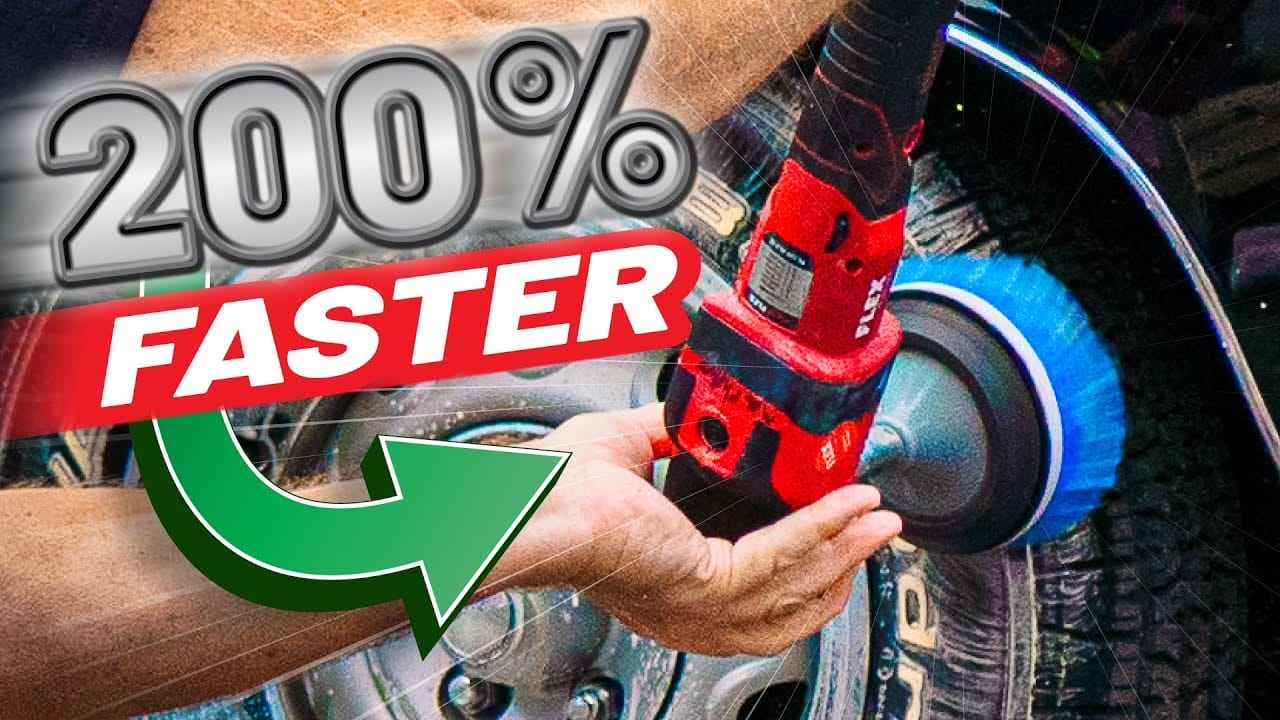
When it comes to getting severely neglected and dirty tires factory clean again, there’s the old-school way of doing it working by hand using a tire scrub brush and the modern way of doing it, and that’s machine scrubbing using cordless rotary polishers.
SAFETY WARNING: Because washing a car and cleaning wheel and tires falls under the category of Wet Work, it’s important to only do this type of work with cordless tools, not tools that would be plugged into an electrical outlet due to the electrical shock risk.
Demonstration Vehicle: 1932 Ford 3-Window Coupe
This is actually one of 7 training cars for an upcoming paint correction and ceramic coating class.
The tires on this car are extremely neglected and have become stained with dirt and tire browning, also called tire blooming over the years. Tires with this level of staining can be cleaned by hand using a tire brush and a tire cleaner but let me show you an easier and faster way to get them clean and also a much more efficient method – working by machine.
Supplies Needed
The first thing you need to do is gather together all the tools and products you’ll need for pro-quality results. This includes:
- Cordless rotary polisher.
- 3” rotary polisher extension.
- 5” rotary polisher brush.
- 5” rotary backing plate.
- Soft Scrub Cleanser – basically a liquid version of Comet Cleanser.
- Acid-free wheel cleaner – Dr. Beasley’s Premium Wheel Cleaner.
- Degreaser – Dr. Beasley’s Premium Degreaser.
- Wheel cleaning brush.
- Small dish of some type with an inside diameter of at least 5 inches.
- Small detail brush for cleaning around air valve stem, lug nut barrels and around lug nuts.
- Ergo seat cushion to be comfortable as well as keeping you dry.
3” Rotary Polisher Extension
You can machine clean the tires without the 3” extension, but the reason I use and show the extension is because it moves the BODY of the tool away from the tire and this enables you to push the spinning brush bristles against the flat spot where the tires touches the pavement. Of course, you can also roll the car forward or backward to access the very lowest portion where the tire contacts the pavement as an option.
How to Clean Tires: My 2-Part Process for Tire Cleaning
In this video/article, I’m showing you a 2-step tire scrubbing procedure. The first step is a mechanical cleaning as there are gentle abrasives inside the Soft Scrub Cleanser. For most tires, this is more than enough to get them clean.
As an option, you can also do a chemical cleaning step using your favorite tire cleaner and/or degreaser. I’ll share both methods below and you can choose just how OCD you want to get.
Part 1: Mechanical Tire Cleaning
- Pour Soft Scrub Cleanser into bowl.
- Dab the end of the brush bristles into the bowel and gather up some Soft Scrub.
- Dab the Soft Scrub Cleanser around the sidewall of the tire to spread it out.
- Turn the polisher on, lock the power lock button, hold the tool from the extreme positions and start scrubbing the tire sidewall.
- After scrubbing, rinse the tire with a blast of water.
- Rewash the tire using a brush and your car wash solution to agitate and remove any trace residues of the Soft Scrub Cleanser.
- This Dr. Beasley’s Wheel Brush has long, flexible bristles, and the tips of each bristle are split or what they call flagged. This enables the brush to get into tight areas to agitate and remove brand dust.
Important Tip: Clean the rotary brush in between scrubbings!
In the picture below, you can see all the blackish dirt and grime on the bristles of the brush. If you don’t clean this grime off, each time you use the brush you’ll simply re-introduce the grime to the tire sidewall you’re trying to clean.
Cleaning is fast and easy. Simply hold the water sprayer into the bristles then run the polisher while flushing the bristles with water.
In just a few seconds, the bristles will be flushed clean and now the brush is ready to use again.
Part 2: Chemical Tire Cleaning
- Spray some tire cleaner or degreaser onto the tire sidewall.
- For this step I’m using Dr. Beasley’s Premium Degreaser, which will break down and remove any residues not removed from the first cleaning step.
- Machine scrub the tire sidewall.
- Spray wheel cleaner onto the wheel.
- For this step I’m using Dr. Beasley’s Premium Wheel Cleanser, which is a non-acid wheel cleaner that removes brake dust and road grime. The thick, gel-like formula clings to vertical surfaces instead of running off onto the ground and because it’s non-acid, it prevents staining and etching of the rim surface.
- Agitate wheel cleaner using wheel brush.
- After cleaning the wheel, run the brush over the tire sidewall to re-liquify and agitate any degreaser or tire cleaner.
- Give the wheel a thorough rinse and lastly, rinse the tire for a last time.
Final Results
This picture can be a tick deceiving as the rubber sidewall is wet with rinse water giving it the appearance of a factory-new, dark black tire sidewall. Let me dry the rubber sidewall off to see the true condition and level of cleanliness, especially compared to the BEFORE pictures.
To really see how clean the tire sidewall is, I take my EGO Leaf Blower and dry off the rinse water.
Now these are what I call clean!
Yes they are dull and lifeless looking, but now they are perfectly prepared to accept the Dr. Beasley’s Tire Conditioner, which will create a deep, dark black sheen.
How to Apply A Tire Dressing or Conditioner by Machine
After repeating the same above process to the other 3 wheels and tires, I then moved the 1932 Ford 3-Window Coupe into the Dr. Beasley’s Training Garage to machine apply the dressing.
To machine apply the tire dressing, we’re going to use the same rotary polisher and rotary brush, and this is another reason why you want to clean your brush after use so it’s clean and ready to go for the next step.
My Recommended Tire Dressing/Conditioner
The Dr. Beasley’s Tire Conditioner will restore moisture, nutrients, and a deep, dark black color to the tires. It helps to resist UV damage from the sun while preserving the appearance and life of the tire sidewall.
To apply the Dr. Beasley’s Tire Conditioner, you can either pour some onto the tire from the tube, squeeze some out onto a staining brush, or like you see me do, simply squeeze a little product into your bowl and then use the staining brush to apply the dressing to the tire sidewall.
I prefer to squeeze some tire conditioner into the bowel I used to hold the Soft Scrub Cleanser, (after washing it out first of course), simply because it’s easier and I can spread an even amount of product over the sidewall in preparation for working the tire conditioner into the rubber via the rotary brush.
Tip: Use the Power Lock Button on your Rotary Polisher!
Here’s something I practice and teach in all my car detailing classes, and that is, instead of using your fingers to hold the speed trigger in the entire time you’re using the polisher, depress the speed trigger all the way, and then using your finger, press the Speed Lock Button in and this will hold the polisher at the RPM speed setting you set with the Speed Dial.
Once you have turned the polisher on to the low speed setting and locked-in this speed using Speed Power Lock button, next begin massaging the tire dressing over and into the tire sidewall.
Where I’m pointing is the flat spot where the tire meets the concrete in our shop. This is where the 3 inch rotary extension comes in handy again. The extension moves the head of the tool body away from the tire enabling you to press the spinning brush bristles against the lowest part of the tire for uniform tire dressing coverage.
One benefit for machine applying a tire dressing is the spinning brush bristles work the tire dressing into all the lettering and what’s called tire siping, (lines in the tire), better than using conventional methods like tire swipes and tire sponges.
Don’t Forget to Remove the Excess!
The number one reason people experience tire dressing sling or dressing splatter on the sides of their car after driving after applying most tire dressings, is because there’s excess tire dressing still on the surface of the tire sidewall.
To avoid any chance of tire dressing sling or splatter, simply give the tire sidewall a thorough wipe-down using a simple, cotton, terrycloth wash cloth. Unlike microfiber, terrycloth has a little stoutness to it, and this simply works better for this purpose than microfiber.
Here’s the final results!
Here’s a deep, dark black rich looking tire sidewall that’s dry to the touch and non-greasy. And because we wiped-off any excess, there’s no risk for tire dressing sling or splatter onto adjacent body panels.
Here’s a deep, dark black rich looking tire sidewall that’s dry to the touch and non-greasy. And because we wiped-off any excess, there’s no risk for tire dressing sling or splatter onto adjacent body panels.
Here’s the results for all 4 tires after a thorough machine cleaning and machine application of the tire conditioner.
Here’s everything I used for both procedures – machine scrubbing tires clean and machine applying the tire conditioner.
Next up – Removing oxidation and polishing aluminum wheels!
Have you ever wondered how to make quick work for removing oxidation and restoring a chrome-like shine to dull, oxidized aluminum wheels like you see on the 1932 Ford? Here’s the good news, after cleaning the wheels and tires, I tested 4 different popular metal polishing balls and shared my thoughts on which one does the best job.
Click the link below to watch the video and see all the pictures from this wheel polishing project.
The Best Polishing Balls for Aluminum Wheels
My Personal Offer to Help
I’ve been answering car detailing questions professionally since 2002 and moving forward, if after reading this article you have any questions about polishing and waxing, or how to use an AIO, my contact information is below, reach out to me, I’m always happy to help.
Would You Like to Learn How to Machine Polish Like a Pro?
- Would you like to take your detailing skills to a higher level?
- Do you find you learn better by doing versus sitting in a chair looking at a PowerPoint presentation about car detailing?
Here at Dr. Beasley’s O.R., (Operating Room), in sunny Stuart, Florida, we teach the most hands-on car and boat detailing classes on planet Earth. And we prove it too. You can find write-ups on the Dr. Beasley’s Blog that photo-documents just how hands-on our classes are plus you’ll see the kinds of cars and boats you’ll be training on.
Click the link below to find the dates, locations, topics, and prices for all upcoming detailing classes.
Upcoming Detailing Classes – Prices – Info – Topics – Locations
And if you ever have any questions, always feel free to reach out to me personally via text, phone call or email.
I hope to see you in a future detailing class!
Sincerely,
Mike Phillips
Chief Education Officer for Dr. Beasley’s
Mike@drbeasleys.com
760-515-0444
Questions? Comments?
Email Us