



In the piece on why one interior cleaner can’t clean every stain, I made the case that strength is the wrong axis to think about. The real variable is chemistry matched to soil. That piece stayed at the practical level on purpose. This one goes underneath it, into the formulation chemistry that actually explains why a “milder” cleaner can outperform a “stronger” one.
Fair warning: this is a deeper dive than a typical blog post. If you formulate products, train technicians on chemistry, or just like understanding what’s actually happening in the bottle, this one is for you.
Surfactant Class Is a Starting Point, Not an Answer
When people compare cleaners, they often reach for shorthand like “it has anionic surfactants” or “it’s nonionic-based,” as if that settles how the product will perform. It doesn’t.
A formulator chooses a surfactant system based on a whole set of variables working together: the polarity of the soil, the surface being cleaned, wetting requirements, emulsification needs, pH, water hardness, solvent choice, builders, and sometimes enzymes. Surfactant class is one input among many, not the whole formula.
The most useful way to think about it is soil-first, not surfactant-first:
| Soil / Problem | Chemistry Usually Favored | Why |
| Heavy oils, grease, petroleum | More hydrophobic nonionic surfactants, often blended with anionics, solvent, and alkalinity | Penetrates and solubilizes oily soil, lowers oil-water interfacial tension |
| Road film | Anionic + nonionic blend, plus builders/chelants, often alkaline | Road film is a mixture of oil, soot, particulate, and minerals, so it needs more than one mechanism |
| General dirt/particulate | Anionic surfactants | Excellent wetting, soil lifting, and particulate suspension |
| Food/beverage residue | Usually milder mixed surfactant systems, often nonionic/amphoteric/anionic, chosen for proteins, sugars, fats | Food is chemically diverse, so “strength” isn’t the controlling variable |
| Body oils, sunscreen, cosmetics | Nonionic-rich system, sometimes solvent-assisted | Strong affinity for hydrophobic, oily contamination |
| Protein stains | Surfactant plus often a protease enzyme | Surfactants alone don’t necessarily break protein molecules apart |
| Starch/food thickener | Surfactant plus sometimes amylase enzyme | Amylase breaks starch into more soluble fragments |
| Fatty food soils | Nonionic surfactants, sometimes lipase | Helps emulsify fats; lipase can hydrolyze triglycerides |
| Mineral/salt deposits | Usually acid or chelating chemistry, not primarily a surfactant problem | Minerals need to be dissolved or complexed, not emulsified |
The surfactant detergency literature backs up part of this pattern directly: nonionic surfactants tend to be especially effective against oily soils, while anionics tend to excel at particulate-soil removal and also contribute to emulsifying oily soil. That split is worth understanding in more depth, because it explains a lot of what separates a good cleaner from a mediocre one.
For Grease and Petroleum, Look Hard at the Nonionics
For engine grease, lubricating oil, petroleum residue, body oils, and similar hydrophobic contamination, one of the classic tools is the alcohol ethoxylate family. On an ingredient list you might see names like:
- C9-11 Pareth-x
- C10-12 alcohol ethoxylate
- C12-15 Pareth-7
- C9-11 Pareth-6
- Secondary alcohol ethoxylate
- Isotridecyl alcohol ethoxylate
- Ethoxylated fatty alcohol
These are all nonionic surfactants, and there’s an important formulation variable hiding inside that family: how much ethoxylation there is.
Broadly speaking, fewer ethylene oxide (EO) units make an alcohol ethoxylate more lipophilic, meaning it has a greater affinity for oily material. More ethoxylation makes it more water-loving. Detergency references specifically note that alcohol ethoxylates with roughly 3 to 5 EO units are relatively hydrophobic and particularly good emulsifiers and greasy-stain removers.
That distinction matters more than it might seem. Two cleaners can both list “nonionic surfactants” on the label, and one can still be substantially better at grease because of the specific carbon chain length and EO distribution the formulator chose. Reading “nonionic” tells you the category. It doesn’t tell you the performance.
Think HLB, Not Just Ionic vs. Nonionic
For anyone doing real formulation work, HLB, hydrophilic-lipophilic balance, is a much more useful concept than the ionic-versus-nonionic split.
Every surfactant molecule has two ends: a hydrophobic tail that likes oil, and a hydrophilic head that likes water. The formulator is balancing those two affinities against each other for a specific job.
A relatively lipophilic nonionic can work its way into an oily soil and help pull that oil into the aqueous cleaning solution. The surfactant molecules then form structures like micelles or microemulsion phases that keep the oil dispersed so it can be wiped or rinsed away rather than redepositing. Oily-soil removal is strongly tied to these interfacial and solubilization or emulsification phenomena.
Put in plain terms for a customer-facing explanation: some surfactants are built to interact more effectively with oily contamination, while others excel at wetting surfaces, lifting particles, or suspending soil in water. A good cleaner uses the right combination for the type of contamination it’s expected to face. That’s scientifically accurate without turning into a chemistry lecture, which is exactly the balance the main blog post is trying to strike.
What Anionic Surfactants Are Good At
Typical anionic surfactant families include:
- Linear alkylbenzene sulfonate (LAS)
- Alpha olefin sulfonate (AOS)
- Sodium lauryl sulfate (SLS)
- Sodium laureth sulfate (SLES)
- Alkyl sulfates
- Alkyl ether sulfates
- Sulfosuccinates
- Various sulfonates
These carry a negative charge in solution, and they’re generally very good at wetting, penetrating soil, lifting particulate contamination, suspending soil, emulsifying some oils, and producing foam, though foam itself is not a measure of cleaning ability. Anionics are a major backbone of detergent formulations partly because most surfaces and particulate soils behave favorably with their charged head groups during soil removal.
Road Film Isn’t a One-Surfactant Problem
For road film, I would rarely ask “anionic or nonionic?” I’d ask for both, because road film is genuinely ugly chemistry. It typically includes petroleum and oil residue, tire compound, exhaust-derived material, carbonaceous particulate, dust, brake contamination, road salts, organic material, and general traffic film. No single surfactant mechanism ideally attacks all of that at once, which is why a good traffic-film remover or vehicle wash detergent usually runs a mixed surfactant package rather than leaning on one class.
Why Nonionic Plus Anionic Can Be So Powerful Together
A nonionic can provide excellent oily-soil affinity and emulsification. An anionic can provide strong wetting and particulate removal. Put them together correctly and you can get synergistic interfacial behavior that neither delivers alone. Mixed anionic and nonionic systems have been extensively studied for oily-soil removal, including their ability to achieve very low oil-water interfacial tension and favorable microemulsion behavior.
So for something like an engine cleaner, the formulation architecture I’d expect looks more like this:
Nonionic surfactant, plus anionic surfactant, plus an alkaline builder, plus solvent, plus chelator, plus hydrotrope.
Not “extra-strong surfactant.” That’s where real cleaning power comes from, and it’s a system, not a single ingredient turned up.
The Solvent Is Doing a Different Job Entirely
This matters especially for grease and engine cleaning. A product might contain a glycol ether, such as dipropylene glycol methyl ether (DPM), propylene glycol n-butyl ether (PnB), DPnB, butyl glycol (EGBE), or another glycol ether, or a terpene solvent like d-limonene. These are not surfactants.
The solvent’s job is to penetrate and dissolve oily contamination directly. The surfactant system then helps emulsify and disperse that loosened oil into the aqueous phase so it can actually be removed from the surface rather than just softened in place. That combination, solvent to loosen plus surfactant to carry away, is why an engine degreaser can dramatically outperform an ordinary interior cleaner even though both technically contain surfactants. You’re attacking the same contamination through more than one mechanism at once.
Foodstuffs Deserve More Precise Language
Here I’d sharpen the terminology I’ve used loosely in the past. I wouldn’t scientifically call food and beverage contamination simply “organic contamination,” because petroleum oil, skin oil, and gasoline residue are technically organic compounds too. What we really mean is something closer to food- and biologically-derived soils, and even that category isn’t one chemical.
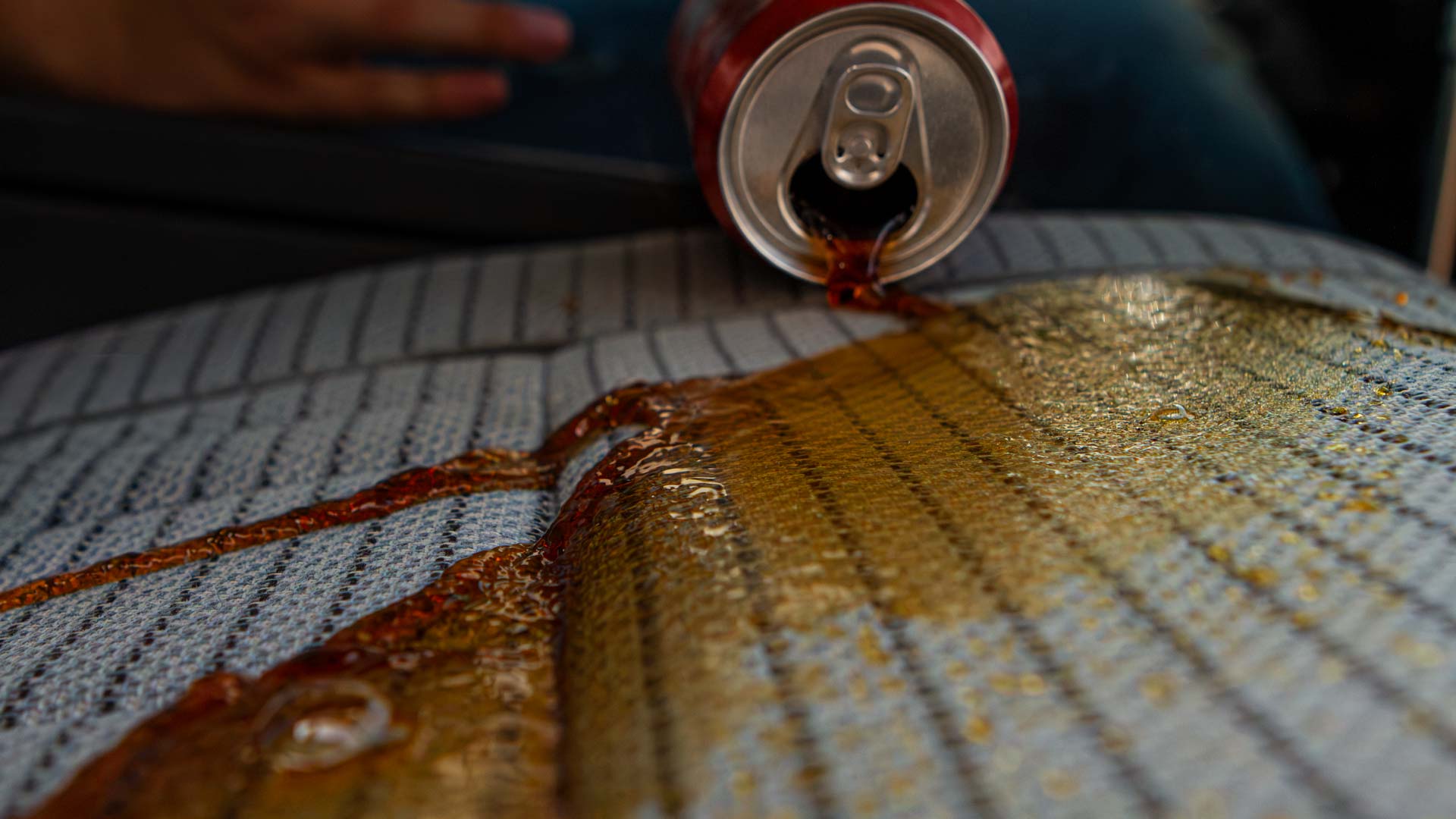
A soda spill might contain water, sugars or high-fructose corn syrup, acids, caramel color, and flavor compounds. A milkshake carries sugars, protein, and fat. Pizza sauce brings oils, protein, carbohydrates, pigments, and acids. Chocolate has fats, sugars, proteins, and pigments. There’s no such thing as “food surfactant.” A good food-stain cleaner has to be formulated to handle several of these components at the same time.
Sugars Behave Differently Than Grease
Sugars are highly polar and water-soluble. You don’t need a powerful oil-solubilizing surfactant to deal with sugar the way you need one for petroleum grease. Water already does much of that work. What the cleaner actually needs to do is wet the fibers, penetrate dried residue, rehydrate the contamination, release it from the substrate, handle any oils, colorants, or proteins riding along with it, and carry the loosened contamination away.
That’s a fundamentally different problem than removing motor oil, and it’s very likely the real explanation behind the Coke-stained headliner story from the main post. The “strongest” cleaner the team reached for first was probably optimized toward grease, oils, or heavy general soil. The cleaner that actually worked had a surfactant, solvent, and pH system much better suited to rewetting and releasing dried beverage residue. The second product wasn’t weaker. It was better matched, chemically and thermodynamically, to that particular soil.
Protein Is Where Surfactants Reach Their Limits
Milk, egg, blood, vomit, and certain food residues bring protein into the picture, and this is where surfactants alone start to fall short. Surfactants help wet, emulsify, and remove protein-based soils, but there’s a more powerful tool available for this specific job: protease enzymes, which chemically cleave proteins into smaller fragments that are far easier to lift and rinse away.
The same logic extends across several enzyme classes, each matched to a specific molecule:
- Protease breaks down protein
- Amylase breaks down starch
- Lipase breaks down fats and triglycerides
- Cellulase addresses certain carbohydrate and fiber-related soils
This is exactly why sophisticated laundry and food-processing cleaners don’t rely solely on “strong surfactants.” They match a biochemical tool to a specific molecule, which is the same philosophy the main blog post is built around, just one level deeper.
A Quick Word on Amphoterics and Cationics
Amphoteric surfactants, things like cocamidopropyl betaine, alkyl betaines, amphodiacetates, and amine oxides (which behave as nonionic or cationic depending on pH), are often used for mildness, wetting, foam modification, compatibility, boosting detergency, and improving mixed surfactant systems. I wouldn’t call them “the food-stain class.” They’re more often a supporting player in a carefully engineered system rather than the lead ingredient.
Cationic surfactants are a different category altogether. Quaternary ammonium compounds, like benzalkonium chloride or didecyldimethylammonium chloride, are much more associated with antimicrobial action, surface substantivity, conditioning, and antistatic effects than with broad detergency. Cationics and anionics can also be chemically incompatible, since they can form ion pairs or precipitates in solution, so a formulator can’t simply mix the two without accounting for that.
Reading an Ingredient Deck: What the Clues Actually Mean
If you handed me two cleaners and asked what the chemist behind each one was trying to accomplish, here’s what I’d look for:
Alcohol ethoxylates or Pareths. A strong clue toward grease and oily-soil detergency, especially the lower-EO materials.
LAS, AOS, SLES, sulfates, or sulfonates. Strong detergency, wetting, and particulate-soil removal.
APG (alkyl polyglucosides). Nonionic surfactants with strong wetting and broad detergency, often chosen when mildness and environmental profile matter.
Amine oxide or betaine. A secondary surfactant, usually a wetting, foam, or detergency booster, and often an improvement to mildness.
Glycol ethers. Solvent assistance, usually pointing toward oily soils, grease, adhesives, or difficult organic residues, depending on the specific solvent.
Metasilicate, carbonate, or hydroxide. Alkalinity and building. A strong clue toward degreasing and heavy soil.
Citrate, GLDA, MGDA, or EDTA. Chelation and sequestration of calcium, magnesium, metals, and mineral-associated soil.
Protease, amylase, or lipase. A very strong signal that the product is deliberately built around biological, food, or laundry-type soils.
Organic acids such as citric, glycolic, or lactic. Depending on concentration and pH, these can point toward mineral-scale or inorganic-deposit removal rather than grease removal.
Why You Can’t Judge a Cleaner from the SDS Alone
One important caveat: you cannot reliably judge a cleaner’s performance from its Safety Data Sheet. An SDS is a hazard communication document, not the formula. A surfactant below a certain reporting threshold may not even appear on it, and manufacturers can use generic chemical descriptions that hide the specifics.
What an SDS won’t tell you includes exact ratios, EO distribution, HLB, active concentration, micelle structure, cloud point, hydrotrope level, builder package, precise pH buffering, or proprietary ingredients. For real formulation work, a supplier’s technical data sheet and the actual formulation are far more informative than the SDS ever will be.
A Starting-Point Formula: Food, Beverage, and Tannin-Type Soil
All of that theory is more useful with a worked example attached, so here’s roughly how I’d sketch out a starting formula for the exact soil type that started this whole conversation: dried beverage and light food residue with tannin-type staining, the headliner problem.
This is a directional starting point for bench screening, not a finished, tested product, and it’s built as a ready-to-use spray, the kind you’d mist directly on a stain, not a concentrate meant to be diluted. That distinction matters more than it might seem. A concentrated pretreatment product can run 20 to 50 percent total surfactant actives. A ready-to-use spray typically runs a small fraction of that, because the product is doing its work undiluted, straight out of the bottle. Real formulation work still requires stability testing, substrate compatibility testing, preservative efficacy testing, and a proper safety and regulatory review before anything goes near a shelf. But it shows the logic in action.
| Ingredient (INCI-style) | Function | Typical Range |
| Water | Carrier | Qs to 100% |
| Alcohol ethoxylate, C9-11, 5-6 EO (nonionic) | Cuts any co-mingled fats or creamer oils without over-indexing on grease chemistry | 1.0-2.5% |
| Sodium laureth sulfate or sodium C14-16 olefin sulfonate (anionic) | Wetting, particulate lift, general detergency | 1.0-2.5% |
| Cocamidopropyl betaine (amphoteric) | Mildness, foam control, improves compatibility between the nonionic and anionic | 0.5-1.5% |
| Tetrasodium glutamate diacetate (GLDA) or sodium citrate (chelator) | Sequesters hardness minerals and helps release tannin-metal complexes bound to fiber | 0.2-0.5% |
| Sodium carbonate or a small amount of triethanolamine/AMP (mild alkaline builder) | Buffers pH to roughly 8-9.5, enough to help rehydrate and loosen sugars and light protein without being aggressive on dyed fabric or coated surfaces | 0.3-1.0% |
| Sodium cumene or xylene sulfonate (hydrotrope) | Keeps the surfactant blend clear and stable, improves rinseability | 0.5-1.0% |
| Glycol ether, e.g. dipropylene glycol methyl ether (solvent, optional) | Assists if the soil carries any oily component, like coffee creamer | 0.5-1.5% |
| Preservative system | Microbial stability | Per supplier guidance, typically 0.1-0.5% |
| Citric acid or sodium hydroxide | Final pH adjustment | Qs to target pH |
| Fragrance | Consumer experience | As needed |
Process-wise, I’d dissolve the chelator and builder into the water first, add the surfactant blend slowly with low-shear mixing to avoid whipping in excess foam, bring in the hydrotrope to keep everything clear, then the solvent, and add preservative and fragrance last once the base is stable. Adjust pH at the end.
One optional variable worth testing: a small dose of protease, in the range of 0.1-0.3%, if the target soil regularly includes protein, milk being the obvious back-to-school example. That range sits comfortably inside the 0.01 to 0.5 percent range typically cited for protease in liquid detergent formulations, and alkaline proteases generally do their best work around pH 8 to 11, which is part of why I targeted the higher end of the pH range above rather than a neutral formula. Enzymes are also sensitive to temperature and to some preservative and surfactant systems, so compatibility is a bench question, not something to assume will work by just adding it to the tank.
A quick note on where this table came from. It’s built from standard formulation logic, the same reasoning used throughout this piece, not copied from a commercial product or a supplier’s exact recipe. I checked the ingredient classes and rough ranges against published patent examples and enzyme supplier technical guidance rather than publishing them on instinct alone, and I’d treat the surfactant, chelator, and hydrotrope numbers as a reasonable starting point still worth confirming against your own raw material technical data sheets, since exact optimal levels shift with the specific grade and supplier you’re sourcing from.
The point of walking through this isn’t the exact percentages, which any formulator would refine through real bench work and testing. It’s that none of this reads as “make it stronger.” Every choice here is answering a specific question: what soil, what surface, what mechanism, and only then, what chemistry.
The Framework I Actually Use
Strip away all the specifics above and this is the formulation matrix I come back to:
- Identify the soil chemistry. Polar, nonpolar, particulate, protein, mineral, or mixed.
- Identify the substrate. Leather, textile, plastic, paint, engine bay, wheel, and so on.
- Select the primary cleaning mechanism. Wetting, solubilization, emulsification, dispersion, hydrolysis, or chelation.
- Then choose the chemistry. Surfactant class, HLB, solvent, builder, enzyme, chelant, and pH, all working together.
That’s a far more accurate model than mild, medium, strong, and it’s the model every formulation on our shelf actually gets built from.
It also puts a sharper point on the headliner story from the first post. The mistake that day wasn’t that the team chose a cleaner that wasn’t strong enough. They chose a cleaner whose chemistry was built for a different type of soil entirely. Once we matched the chemistry to the actual contamination, the “milder” cleaner did the job faster and safer than the strongest thing on the shelf. That’s not a coincidence. That’s how surfactant chemistry actually works.
Questions? Comments?
Email Us