


Your wheels don’t always need a full wash.
If you’re dealing with a light layer of brake dust, fresh road film, environmental dust, or minor water spotting, setting up a hose, buckets, wheel brushes, and a complete wash process can be more than the job requires.
That’s where waterless wheel maintenance makes sense.
The key is knowing when it’s appropriate, how to do it safely, and when the wheel is too dirty to wipe.
When Waterless Wheel Cleaning Makes Sense
Waterless wheel cleaning is a maintenance process, not a deep-cleaning process.
It’s best suited for wheels that are still fundamentally well maintained but have started to lose their freshly detailed appearance between washes — think light brake dust, environmental dust, fresh road film, minor water spots, or light surface contamination from normal driving.
At this stage, the contamination is light enough that you don’t necessarily need a traditional wheel cleaner, agitation, and a full rinse. With Wheel Detailer, you can use a Spray & Wipe method to clean the wheel without running water.
But before you reach for the towel, inspect the wheel.
Inspect Before You Wipe
The most important part of any waterless cleaning process happens before the towel ever touches the surface.
Look closely at the wheel. If you see loose grit, sand, mud, heavy brake dust, or thick road grime, don’t wipe it across the finish. Those larger or more abrasive particles can become trapped between the towel and the wheel surface, and once pressure is applied, you’re effectively dragging that contamination across the finish — that’s where the risk of scratching increases.
If the wheel is more contaminated than you expected, change the process:
- Use Wheel Detailer as a Spray & Rinse when the contamination is still relatively light but you’d rather remove it without wiping.
- If brake dust and road grime have accumulated enough to require agitation, it’s time for a proper wheel wash with Premium Wheel Cleanser.
The condition of the wheel should determine the process.
Use Wheel Detailer to Clean Safely
One of the biggest mistakes in waterless cleaning is using too little product. The goal isn’t to lightly mist the wheel and immediately start wiping — Wheel Detailer should be applied generously enough to thoroughly wet the area you’re cleaning. That liquid surrounds and loosens light contamination so it can be removed with less mechanical force. Think of it as creating separation between the contamination and the wheel: let the chemistry do the work, then let the towel remove what the chemistry has loosened. The more you’re relying on the towel itself to scrub the wheel clean, the farther you’re moving away from safe waterless maintenance.
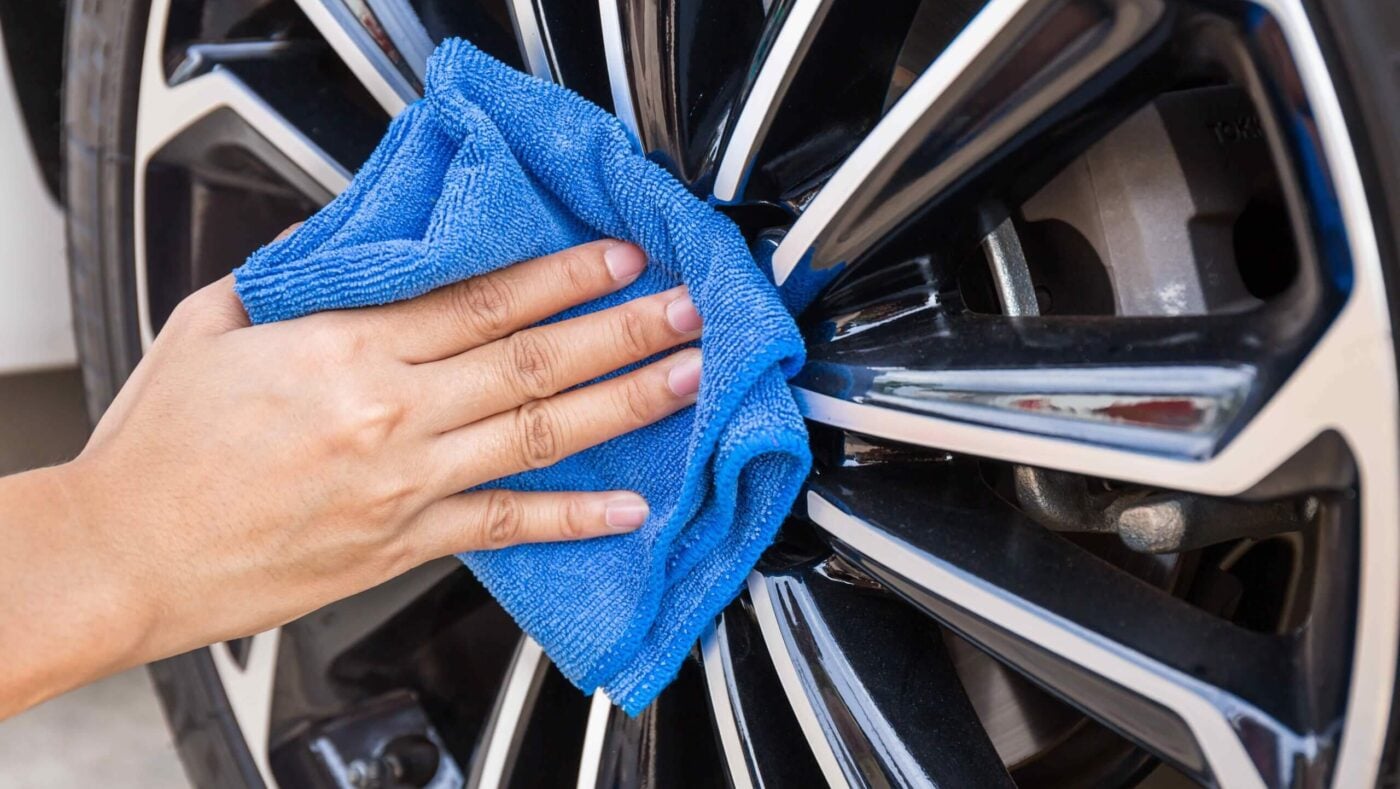
Work in one manageable section at a time rather than spraying the whole wheel and chasing the product as it dries. Spray onto a cool wheel, making sure the surface is adequately wet, then gently wipe with light pressure — you’re not scrubbing brake dust off, you’re picking up contamination the product has already loosened. Once that section is clean, move to the next. This gives you more control and prevents the product from drying before you can remove it.
Your towel matters just as much as your technique. As you wipe, contamination transfers from the wheel into the microfiber — that’s exactly what you want, but it also means the towel gets progressively dirtier as you work. Fold it into sections so you have multiple clean wiping surfaces available, and expose a fresh side after a pass or two. If the towel becomes visibly soiled, replace it. This matters most with brake dust: once contamination is embedded in the towel, continuing to wipe with that same section increases the chance of dragging abrasive particles across the wheel.
Fresh towel surface. Light pressure. Frequent rotation. Those three habits make the biggest difference in avoiding swirls and scratches.
Why cool wheels matter: always work on wheels that are cool to the touch. A hot wheel accelerates evaporation, which means the liquid you’re relying on to wet, loosen, and carry away contamination can begin drying mid-process — cutting short the time the chemistry has to work and giving you less control over the wipe. Never let Wheel Detailer, or any wheel-care product, dry on the surface.
⚠️ Before You Clean Your Wheels…
Wheels take the worst beating on your car — brake dust, road grime, and heat cycles all add up fast. Learn the right products and process with our wheel cleaning tips and techniques guide.
Go to Decision GuideCleaning Is Only Part of the Process
Wheel Detailer isn’t simply a light wheel cleaner. As it lifts contamination, its ceramic (silica-based) formula also cross-links into a thin hydrophobic layer on the surface — the same chemistry family behind long-term ceramic coatings, applied here as a lighter, faster maintenance layer. So one step accomplishes two things: removing the contamination making the wheel look dirty, and adding a fresh layer of water-repellent protection. Once the wheel is maintained, water beads and sheds rapidly from the surface.
For ceramic-coated wheels, this is particularly useful. Brake dust and road film can accumulate on top of an existing coating and mask some of its hydrophobic behavior. Removing that contamination restores the clean surface, while Wheel Detailer adds another spray-applied protective layer on top. It’s not intended to replace a durable, hand-applied wheel coating — it’s a convenient way to clean and reinforce protection during regular maintenance.
Know When to Stop
Waterless wheel cleaning only works well when you respect its limits. If you start wiping and realize the wheel is dirtier than you thought, stop — don’t try to turn a maintenance product into a heavy-duty cleaner by using more pressure. Instead, move up to the process the condition actually calls for:
- Light contamination → Spray & Wipe with Wheel Detailer
- Light contamination, prefer not to wipe → Spray & Rinse with Wheel Detailer
- Accumulated brake dust and road grime → Proper wheel wash with Premium Wheel Cleanser
- Heavy or bonded brake dust → Intensive Brake Dust Remover
Waterless wheel washing isn’t meant to replace every other wheel-cleaning method. It’s meant to fill the space between them.
A Better Way to Maintain Clean Wheels
The traditional approach to wheel care has been to wait until the wheels become dirty enough to justify washing them again. But if you care about keeping your vehicle looking freshly detailed, waiting isn’t always necessary.
Light contamination can be addressed while it’s still light. No bucket. No wheel brush. No complete wash setup. Just inspect the wheel, use enough product, wipe gently with clean microfiber, and know when the condition of the wheel calls for a different process.
That’s the idea behind Waterless Wheel Washing™.
Maintain the wheel before light contamination becomes a full cleaning job.
Questions? Comments?
Email Us