



Last Updated April 27, 2026
Washing a car without a hose removes the single biggest safety mechanism in traditional washing: bulk water removal of particulate matter.
When you eliminate that step, you are fundamentally changing the system.
Instead of relying on water volume to carry contaminants off the surface, you are relying on:
- Surfactant action to reduce surface tension
- Polymer adsorption to encapsulate particles
- Boundary lubrication to prevent direct contact between dirt and paint
If those three conditions are not met, you are not washing the vehicle. You are mechanically abrading it.
Most people approach this as a how-to problem. It’s not. It’s a decision problem.
If you’re unsure which method actually applies to your situation, start with the car wash decision guide.
Why Traditional Washing Works And What You Lose Without It
A hose-based wash relies on fluid dynamics.
High-volume water flow creates:
- Shear force that dislodges loosely adhered particles
- Dilution that reduces particle concentration at the surface
- Transport that physically removes debris from the system
Without that, contamination remains in close proximity to the paint during removal.
That is the core risk.
Research in tribology shows that even small hard particles can create surface defects when dragged across a substrate under load. Automotive clear coat, typically 40–60 microns thick, is especially vulnerable to this type of micro-abrasion.
The Only Way This Works: Replace Water With Chemistry
If you are not flushing contamination away, you must instead control how it interacts with the surface.
Modern rinseless and waterless systems rely on surfactants to detach contamination, polymers to encapsulate particles, and lubrication layers to reduce shear stress during removal. These same surface interactions are also why improper technique during washing or drying can create defects, as outlined in this guide on how to dry your car without scratching.
The Three Valid Hose-Free Methods
Not all no-hose washes operate at the same level. Choosing the wrong one is where damage begins.
| Method | Contamination Level | Risk Level | Key Advantage | Primary Limitation |
|---|---|---|---|---|
| Waterless Wash | Very Light (dust, pollen) | High if misused | Fast, minimal setup | Cannot handle real dirt |
| Rinseless Wash | Light to Moderate | Low when done properly | Balanced cleaning + lubrication | Requires multiple towels |
| Pre-Soak + Rinseless | Moderate to slightly heavy | Lowest without a hose | Reduces friction before contact | More time, more process |
| Traditional Hose Wash | Heavy contamination | Lowest overall | Removes bulk debris safely | Requires access to water |
Method 1: Rinseless Wash (Primary System)
This is the most balanced approach and the closest to a traditional wash.
A rinseless solution is diluted in water and applied using multiple microfiber towels. Each pass introduces a clean, lubricated interface, minimizing the chance of dragging particles across the surface.
Best suited for light to moderate contamination and routine maintenance.
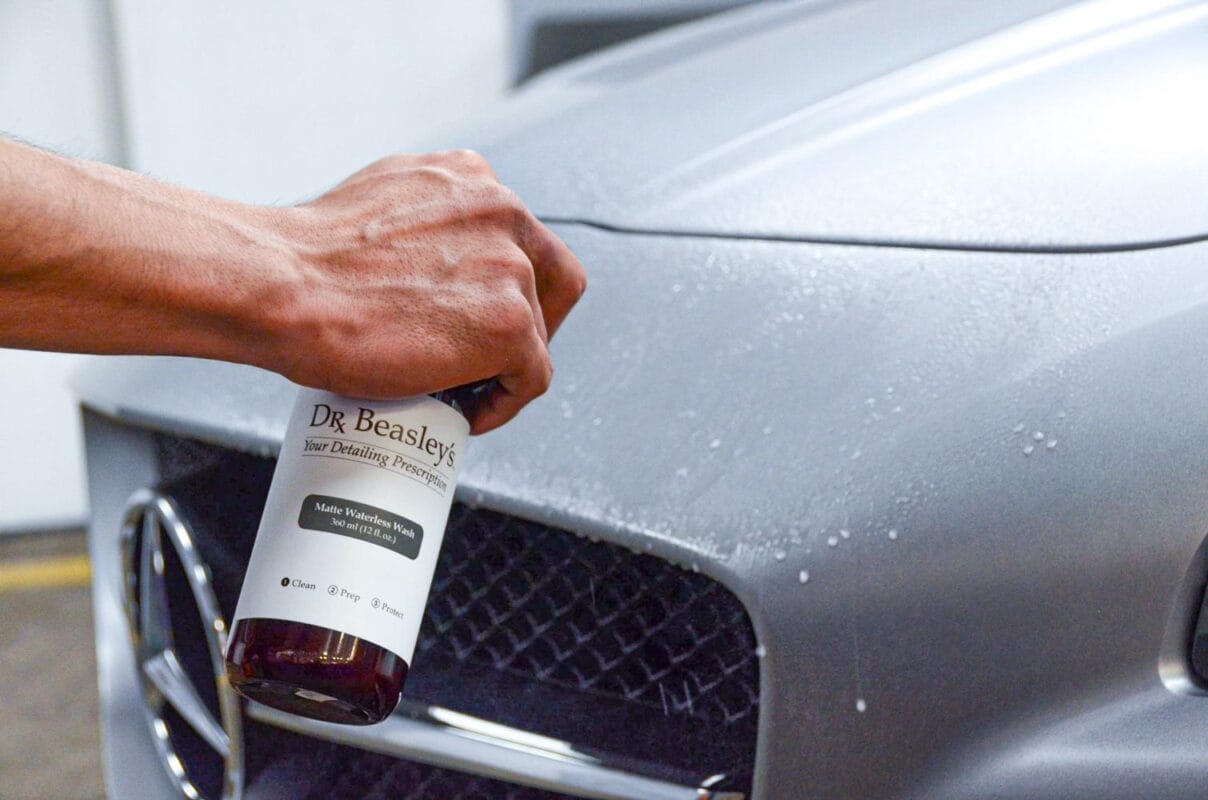
Method 2: Waterless Wash (Low Contamination Only)
Waterless systems rely heavily on lubrication and are only appropriate when contamination is minimal.
Use for dust, pollen, and light surface buildup.
At higher contamination levels, particle separation fails and abrasion risk increases rapidly. This type of improper surface contact is one of the reasons paint defects accumulate over time and eventually require correction, often with machine polishing as outlined here.
Method 3: Pre-Soak + Rinseless (Best Without Running Water)
This method reintroduces a critical missing step: pre-contact loosening.
Using a pump sprayer, a rinseless solution is applied before touching the surface. This allows early surfactant interaction, partial contaminant release, and reduced initial friction.
At this point, most people choose the wrong method based on assumption instead of condition, which is why using the car wash decision guide to match the method to the situation matters.
How to Wash a Car Without a Hose: Why Damage Happens
Failure is almost always due to system overload, not effort.
Too much contamination, not enough lubrication, and reusing contaminated towels all increase friction at the surface. Over time, that repeated friction contributes not just to visible defects, but also to premature failure of protective layers, something explored in detail in this breakdown of why ceramic coatings fail and what actually makes them last.
When You Should Not Wash Without a Hose
There are clear limits to these systems.
Do not use hose-free methods when dealing with heavy mud, sand, salt buildup, or long-neglected vehicles. In these cases, particle load exceeds what encapsulation systems can safely handle.
At that point, proper decontamination becomes necessary before washing can be done safely, which is why understanding when and how to clay the surface is important.
How to Wash a Car Without a Hose: A Practical Observation
In real-world conditions, frequent rinseless washing often results in fewer defects over time.
Lower contamination per wash cycle leads to lower mechanical risk per interaction. Waiting too long between washes increases contamination load and increases the chance of damage during removal.
Consistency matters more than method.
The Bottom Line
Washing a car without a hose is not a shortcut. It is a different system with different constraints.
If the method matches the condition, it can be just as safe and often more practical than a traditional wash. If it doesn’t, it becomes one of the fastest ways to degrade paint.
If you take one thing from this, it’s this:
The method matters more than the effort.
For a complete breakdown of when to use each method, refer to the full car wash decision guide.
Great article just ordered Dr Beasley’s Prep wash and Waterless wash.
Thank you for your business and I’m glad to see you like the techniques shared here.
Mike