

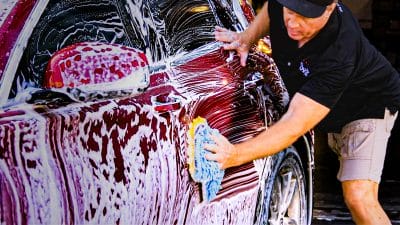


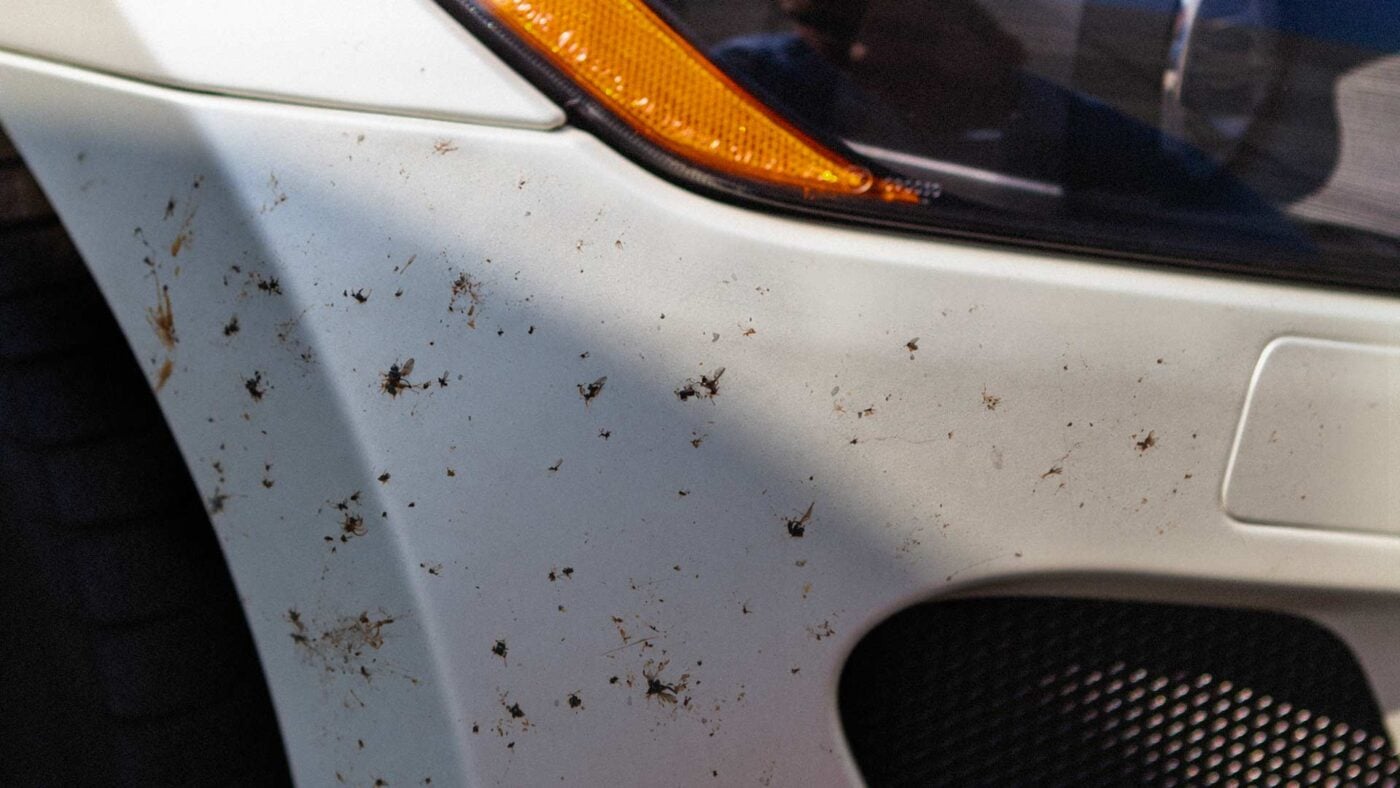
If you’ve driven through Florida during lovebug season, you already know the drill. A few miles on the highway and the front of a clean car turns into a mess of black insect remains across the bumper, mirrors, hood, grille and windshield. During a heavy season it can feel pointless to even bother, because they’re back again the next day.
But lovebugs aren’t just an appearance problem. Left on the vehicle long enough, insect remains can get harder to remove and can end up contributing to staining or damage in the finish. I’ve had cars come through the shop over the years where the customer swore they washed regularly, and you could still see faint etching right where the bugs had baked on the longest. So let’s talk about why that happens, because the real explanation isn’t quite what most people have heard.
How insect remains damage paint
You’ve probably heard that lovebugs damage paint because their bodies are acidic. That’s only half the story—and possibly not even the most important half.
Research cited by the University of Florida Institute of Food and Agricultural Sciences found that freshly macerated lovebugs measured around pH 6.5, fairly close to neutral. After 24 hours, that same material measured closer to pH 4.25, a substantial increase in acidity.
But here’s the surprising part: paint coated with macerated lovebugs showed no damage after 21 days in a humid indoor environment. When lovebug residue was exposed to the sun for an extended period, however, the paint could be damaged.
In other words, a lovebug doesn’t hit your hood as a tiny acid bomb. The real danger develops when its remains are allowed to bake onto the surface. Sun exposure turns an easy-to-remove mess into stubborn contamination that can damage the finish, or force you to damage it while trying to scrub the residue away.
That gives drivers a clear deadline: remove lovebugs before the sun bakes them onto the paint, ideally within 24 hours.
Sunlight increases acidity
Here’s the part that surprised me when I first read it. UF researchers found that paint coated with macerated lovebugs and kept indoors in a humid environment showed no damage after 21 days.
But lovebug-splattered paint exposed to sun for an extended period did show paint damage. The bug remains reacted with the heat and UV rays and became so acidic, they literally attacked the clear coat of the paint they rested on. It’s for that reason UF specifically recommends getting insects off before they’ve been baked onto the surface for a day or two.
So it’s not simply bug plus paint equals damage. It’s closer to bug plus time plus heat plus sunlight plus drying equals rising risk. That’s a meaningful difference, because it means the clock you’re racing isn’t the bug itself. It’s the sun.
Your hood becomes a tiny chemistry experiment
Think about what actually happens after a bug hits your car. At first the residue is mostly water. Then the car sits in a parking lot. The water evaporates, the remaining biological material concentrates and dries against the clear coat, all while chemically reacting with the sun and the environment. What started as a wet splatter ends up as a dry, concentrated deposit bonded to the surface.
Fresh bug, moisture evaporates, residue concentrates, material dries, bonding increases, removal gets harder. Eventually, the bonded material becomes so acidic, it eats into the clear coat. That’s the whole cycle, and it’s why a bug you could rinse off easily an hour after impact can take real effort to remove a few days later.
Sometimes the cleaning does more damage than the bug
Once bug remains harden up, people naturally reach for more force. Bigger scrub, abrasive bug sponge, repeated rubbing on the same spot, sometimes even a household cleaner that has no business touching paint. I saw this constantly at Simon’s Shine Shop. A customer would come in frustrated after fighting a windshield full of dried bugs with a scouring pad, and by the time they got to us there were two problems instead of one.
That’s really two separate risks. There’s chemical damage from the contamination interacting with the finish the longer it sits, and there’s mechanical damage from scratching or marring the paint while trying to force it off. UF’s own research notes that a lovebug-covered surface exposed to sun for an extended period can be damaged both by the bugs themselves and by the removal attempt.
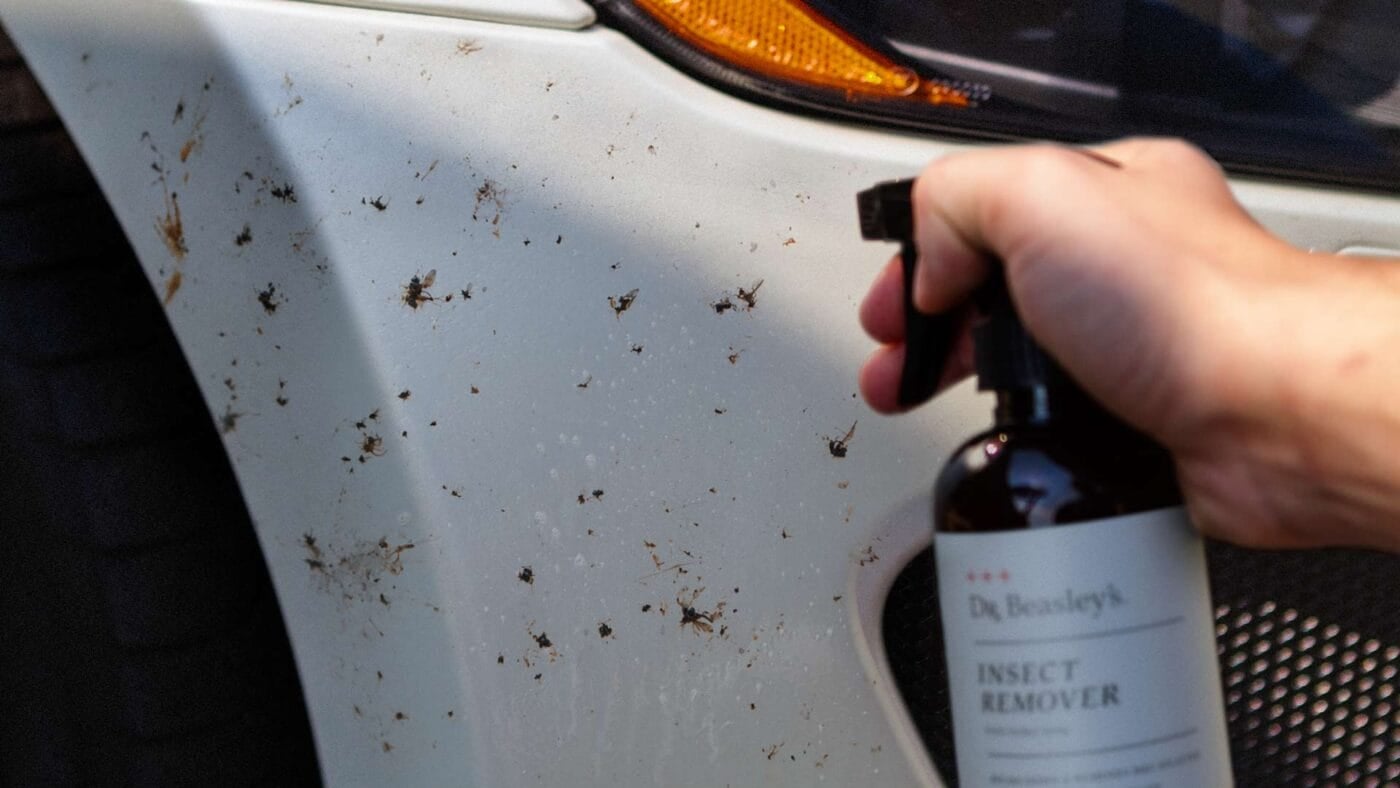
Which gets at one of the most important ideas in safe detailing: let the chemistry do the work before you introduce friction. This is exactly the problem our Insect Remover was built to solve. It’s formulated to loosen bug residue on contact so it lifts away with light agitation instead of a fight, which means you’re not the one doing the damage while trying to fix it.
Why biological contamination can affect clear coat at all
Modern automotive paint isn’t just color with a shiny top. The outer layer on most vehicles is a clear coat, a highly crosslinked polymer system engineered to resist weathering, chemicals, UV and abrasion. Durable doesn’t mean indestructible.
Research on bird droppings suggests that biological contaminants can damage clear coat through chemical reactions with the coating itself, including enzyme-assisted breakdown of its polymers. One study identified enzyme-assisted hydrolysis of the coating polymer as the mechanism.
Lovebugs and bird droppings aren’t the same contaminant, so I wouldn’t assume the exact chemistry is identical, but the broader point holds. Biological material sitting on paint can interact with that polymer in ways that go well beyond just making it dirty.
Why are there so many of these things on the highway anyway
Lovebugs aren’t flying at your car because they like automobiles. UF research reports that female lovebugs can be attracted to UV-irradiated aldehydes associated with exhaust fumes, and heat plays a role too, which may be part of why they cluster around highways. Some of those chemical and thermal cues apparently resemble the smell of decaying organic matter that lovebugs seek out to lay eggs in. On top of that, lovebugs are weak fliers, so a lot of them simply get blown into the path of a car moving at highway speed.
Florida typically sees two big lovebug generations a year, with adults showing up heaviest around April through May and again in August through September. The adults only live three or four days, which isn’t much comfort when that’s exactly enough time to cover the front of your car.
The safest bug is a fresh bug
The practical lesson in all of this is simple: don’t give insect residue time to become difficult. If you’ve driven through a heavy patch of lovebugs, clean the front of the vehicle as soon as it’s reasonably practical. You don’t need a full detail every time. You’re just trying to break the cycle of impact, drying, heat, sun, more drying, before it really sets in.
How to safely remove lovebugs
Work on a cool surface. Move the car out of direct sun when you can and let hot panels cool down. You don’t want your cleaner flashing off before it has a chance to work.
Use chemistry before scrubbing. Apply a dedicated insect remover formulated to break down biological residue, and give it real dwell time so it can penetrate the dried material. This is where Insect Remover earns its keep, it’s built to cut dwell time and cut the amount of mechanical force you need to finish the job.
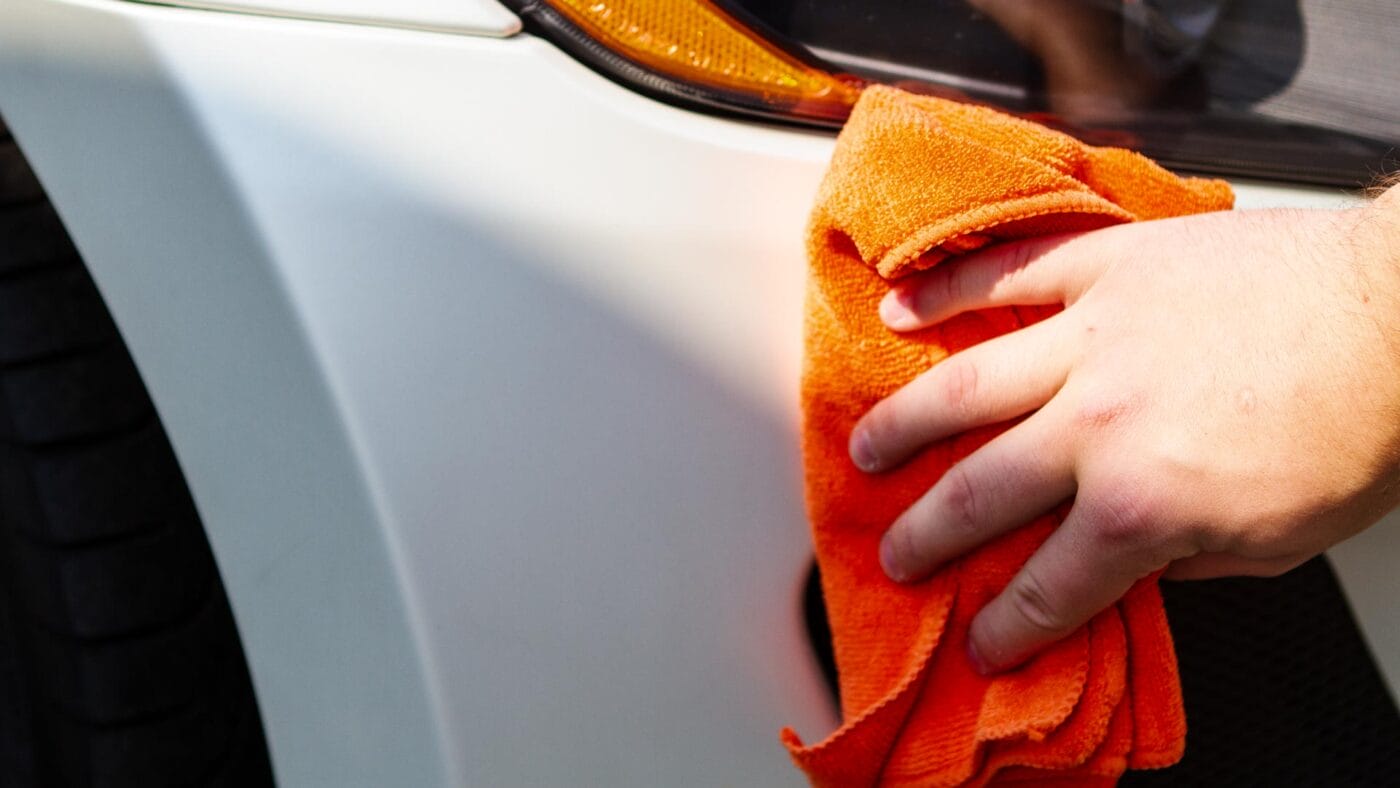
Remove the contamination gently. Use a soft wash media or microfiber towel. If it’s not releasing easily, don’t lean into it harder. Reapply the cleaner and give it another pass. A few gentle cycles beat one aggressive one every time, in my experience that’s true of almost every hard water spot or contaminant, not just bugs.
Inspect the surface once the bug is gone. If there’s still a mark, you might not be looking at contamination anymore. You might be looking at staining or etching, and scrubbing a surface that’s already clean won’t fix that.
Prepare Your Vehicle for Lovebug Season →
Prevention changes the whole equation
The better move during heavy lovebug season is not waiting until a few hundred bugs are stuck directly to bare paint. You change the interface where the contamination lands in the first place, using a sacrificial barrier.
That’s the whole idea behind Bug Barrier. Without protection, the residue lands straight on your vehicle’s surface. With a sacrificial layer in place, the residue lands on the barrier instead. The bugs are still going to hit your car, there’s no product that makes you invisible to a swarm doing 70 down I-75. What changes is how easily and safely that contamination comes off afterward, and that’s a real difference over a long season. Bug Barrier is also safe on matte and satin finishes, so it works as protection across your whole fleet without worrying about altering the sheen.
Cleaning and protection are really one job
During lovebug season I don’t think about bug removal and paint protection as two separate tasks. They’re part of the same system. If you’re already covered in bugs, start with Insect Remover to loosen what’s there without heavy mechanical cleaning. If you’re driving through lovebug country regularly, put down Bug Barrier so the next wave has less of a grip. If you want the whole system built for you, the Bug Barrier Prescription combines both, cleaning what’s already on the car and prepping it for the next drive.
Matte paint needs a more careful approach
Lovebugs are a bigger problem on matte and satin finishes. Gloss paint and matte paint reflect light differently. A standard clear coat is built for uniform reflection, that’s what gives you gloss. Matte finishes intentionally scatter light to get their low sheen look, which means conventional polishing can permanently change how a matte panel looks, leaving a glossier patch where you worked compared to the surrounding paint.
So with matte paint you can’t fall back on “if the bugs leave a mark, I’ll just polish it out later.” You may not have that option. That’s exactly why keeping insect residue from baking onto a matte finish matters so much. Get it off early, don’t scrub aggressively, and use something built for the finish. For tougher contamination, Matte Paint Cleanser gives matte and satin owners a real cleaning option without resorting to traditional polishing. And for prevention on these finishes, Bug Barrier is formulated to be safe on matte and satin surfaces too, so you don’t have to choose between protecting the panel and keeping its factory sheen.
How often should you actually be doing this
There’s no single interval that fits every driver. Think about it in terms of exposure instead.
If you drove through a swarm and the front of the car is covered, get it off as soon as you reasonably can. If you’re seeing moderate accumulation, check the bumper, mirrors and hood after drives and clean regularly. Even light exposure shouldn’t sit ignored for days if the car’s parked in strong Florida sun. The variables that matter are contamination, time, heat and sunlight. As those go up, so should how often you’re cleaning.
A simple lovebug season routine
Before heavy highway driving, apply Bug Barrier to the panels most likely to take impacts, matte, satin or gloss. After heavy exposure, let the car cool if it needs it, apply Insect Remover, give it time to work, then remove the residue gently rather than scrubbing. For matte and satin vehicles, reach for Matte Paint Cleanser when you need something more thorough, and skip the abrasive polish. If you’re dealing with repeated exposure all season, the Bug Barrier Prescription covers the whole cycle in one system.
Lovebugs are temporary. The damage doesn’t have to be.
Lovebugs are just a fact of driving in a lot of Florida during their seasonal peaks. Damage from them isn’t inevitable, though, and the science actually points to a better strategy than just reaching for a stronger cleaner and scrubbing harder.
Fresh lovebug remains start out close to neutral. Then the water evaporates, the biology breaks down, the acidity climbs, and Florida heat and sun push it along even faster. The longer that sits, the harder it gets to remove safely. The answer was never stronger cleaning. It’s earlier cleaning, and better prevention before the next swarm ever hits your hood.
Build your lovebug season defense
Insect Remover — Safely loosens and removes existing insect contamination with minimal scrubbing.
Bug Barrier — Creates a sacrificial protective layer so future bug removal is easier. Safe on matte and satin finishes as well as gloss.
Bug Barrier Prescription — The complete cleaning and protection system for heavy insect season.
Matte Paint Cleanser — Deep cleaning for matte and satin finishes where conventional polishing isn’t an option.
Questions? Comments?
Email Us