


Park a vehicle outside on a sunny August afternoon and you can feel what the sun is doing before you ever see it.
The paint becomes almost too hot to touch. The dashboard heats up. Leather, vinyl, plastics, rubber and exterior trim spend hours exposed to sunlight and elevated temperatures.
Do that occasionally and very little happens.
Do it every day, all summer, and the story starts to change faster than most owners expect.
Paint can lose gloss. Black plastic can turn gray. Rubber can become brittle. Interior materials can fade, discolor or crack. Leather and synthetic upholstery can age prematurely.
We usually describe all of this simply as sun damage.
But sunlight doesn’t damage a vehicle in just one way, and protecting a vehicle from it is more complicated than putting “UV protection” on a bottle.
For decades, automotive protection products relied heavily on waxes, polymer sealants and UV-absorbing additives. Today, ceramic and nanotechnology have given formulators additional tools for protecting surfaces.
So what changed? And does a ceramic coating actually block UV radiation?
The answer is more interesting than a simple yes or no.
What Sunlight Is Actually Doing to Your Vehicle
Sunlight reaching a vehicle contains ultraviolet radiation, visible light and infrared radiation.
UV represents only a portion of the solar energy reaching the vehicle, but it is particularly important because UV photons contain enough energy to initiate chemical reactions in susceptible materials.
In polymers, coatings, plastics and other organic materials, prolonged UV exposure can initiate photodegradation and photooxidation.
In simplified terms, energy from sunlight can contribute to the breaking of chemical bonds. Once that process begins, oxygen can participate in additional reactions that progressively alter the material.
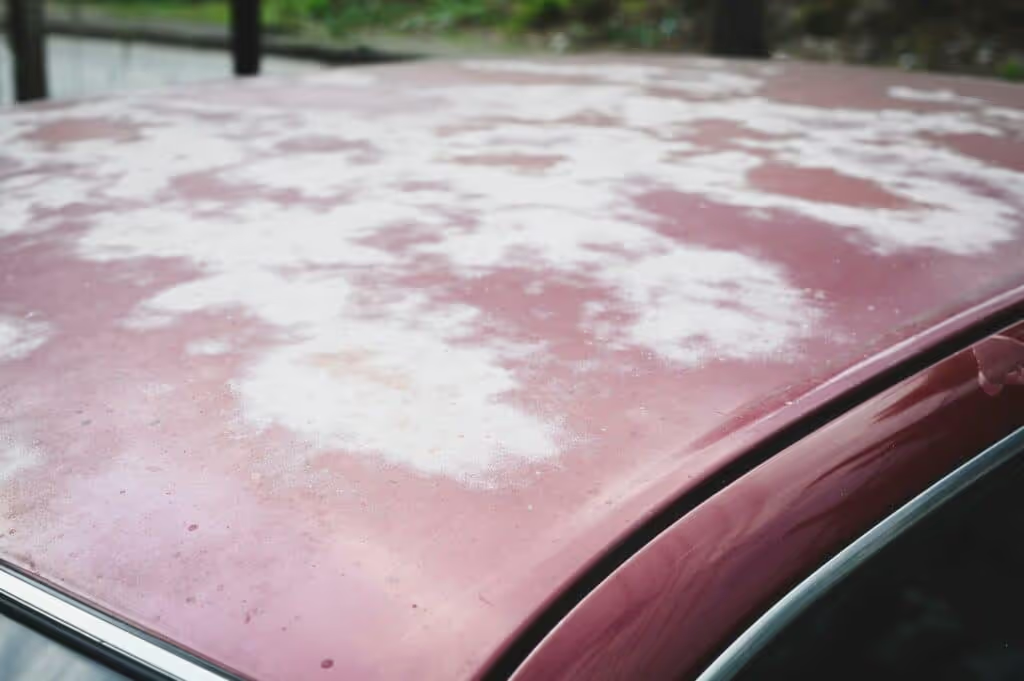
You don’t necessarily notice anything after one sunny day. The effects accumulate. Eventually they can become visible as:
- fading
- discoloration
- chalking
- loss of gloss
- brittleness
- cracking
- loss of flexibility
- deterioration of the coating or surface
Automotive manufacturers already know this, of course. Modern automotive paint systems aren’t defenseless against sunlight.
Clear coats and other polymer systems have long incorporated sophisticated light-stabilization chemistry, including ultraviolet absorbers (UVAs) and hindered amine light stabilizers (HALS).[1]
But even those protective systems have limitations. And that’s where the history becomes interesting.
The Original Strategy: Absorb the UV Before It Does Damage
One traditional approach to UV protection is remarkably similar in concept to sunscreen.
Put a molecule in the material that preferentially absorbs damaging ultraviolet radiation before that energy can initiate unwanted reactions elsewhere in the coating.
These molecules are known as UV absorbers. They have been enormously important in plastics, paints and coatings. Families of UV absorbers include benzophenones, benzotriazoles and hydroxyphenyl triazines, among others.[2]
Automotive clear coats have used UV absorbers to help protect the clear coat itself and reduce the amount of damaging radiation reaching the color coat and underlying layers.[3]
That’s clever chemistry — but it comes with a catch. The protective chemistry itself has to survive the environment.
Research on automotive paint systems has demonstrated that UV absorbers can be lost or photodegraded during prolonged weathering, reducing their protective effect over time.[3][4]
Think about that for a moment. The material protecting another material from degradation is itself being asked to operate in exactly the environment capable of degrading materials.
That’s one reason long-term UV protection has always been a materials-science problem rather than simply a detailing problem.
Then Came Wax
For the vehicle owner, the traditional answer was much simpler: wax the car.
Carnauba waxes and later synthetic sealants created a sacrificial layer over the paint. That layer offered several benefits. It improved gloss, increased water repellency, reduced direct environmental contamination and provided a surface that could gradually be sacrificed instead of leaving the paint completely exposed. Some protectants also incorporated UV-absorbing or stabilizing ingredients.
But wax has an obvious weakness: it doesn’t last very long. Heat, washing, detergents, abrasion, oxidation and environmental exposure gradually remove or degrade it.
This created the traditional automotive protection cycle: apply, degrade, reapply. For decades, that was simply part of owning a well-maintained vehicle.
Then ceramic coatings changed the equation.
⚠️ Before You Apply a Ceramic Coating…
Thinking about protecting your paint with a ceramic coating but not sure where to start? Walk through everything you need to know with our DIY ceramic coating application guide, from prep work to final cure.
Go to Decision Guide| Factor | Traditional Wax or Sealant | Ceramic Coating |
|---|---|---|
| Protective film | Relatively soft, sacrificial layer | Thin, cured and cross-linked film |
| Typical persistence | Shorter-lived; requires frequent reapplication | Designed for substantially longer service |
| Primary strengths | Gloss, water repellency and temporary environmental protection | Chemical resistance, contamination resistance and durable surface protection |
| UV performance | May contain UV absorbers or stabilizers | Depends on the complete formulation—not merely SiO₂ content |
| Maintenance model | Apply, degrade and reapply | Maintain and periodically inspect the bonded coating |
| Important limitation | Heat, detergents and abrasion remove it comparatively quickly | Does not make the surface immune to sunlight or weathering |
What Ceramic Technology Actually Changed
The most important difference between a traditional wax and a modern ceramic coating isn’t that one magically “blocks the sun.” It’s the durability and chemistry of the protective film.
Many modern ceramic coatings use silicon-containing precursors that react and cross-link as the coating cures, producing an extremely thin but durable network bonded to the surface. Instead of depositing a relatively soft, temporary wax film, you’re creating a much more chemically resistant protective layer.
That changes what we’re asking the protection to do. A wax might survive weeks or months. A properly engineered ceramic coating can remain on the surface far longer. And durability matters enormously because protection only works while the protective material is still there.
Ceramic coatings can provide resistance to water, chemicals, environmental contamination and oxidation while reducing the direct interaction between the underlying surface and the environment.
But this is where we need to separate science from marketing.
Does SiO₂ Automatically Block UV?
No. And that’s an important distinction.
Silicon dioxide, or SiO₂, is frequently associated with ceramic coatings. But the presence of SiO₂ does not automatically mean a coating is an effective UV absorber. In fact, silica is used in optical applications precisely because it can transmit portions of the ultraviolet spectrum.[5]
So saying “ceramic coatings contain SiO₂, therefore they block UV” would be an oversimplification.
A better question is: how was the coating engineered?
Modern coatings can use multiple mechanisms to improve weathering performance. The cured coating itself can provide a persistent physical and chemical barrier. A formulation may also incorporate UV absorbers, light stabilizers or inorganic particles specifically selected for their optical properties.
Researchers continue to investigate hybrid nanosystems that combine mechanisms such as UV absorption, scattering and stabilization to improve long-term UV shielding.[6] That’s where “nanotechnology” becomes more than a marketing term.
Particle size, particle chemistry, dispersion, film structure, refractive index, absorption spectrum and photostability can all affect how a coating interacts with light. The technology is in the formulation, not simply in the word ceramic.
UV Protection vs. Weathering Protection
This distinction is probably the most important takeaway.
UV blocking and UV resistance aren’t necessarily the same thing.
Imagine two protective films. Film A absorbs a large amount of UV radiation but deteriorates relatively quickly. Film B absorbs less UV directly but forms a highly durable film that resists oxidation, chemicals, moisture and environmental attack for years.
Which one provides better real-world protection? You can’t answer that question by looking at UV absorption alone.
| Property | What It Means | What It Does Not Necessarily Mean |
|---|---|---|
| UV absorption or blocking | Reduces the amount of UV passing through the film | That the film will remain effective for years |
| UV resistance | Helps the protective material resist degradation from UV exposure | That it blocks all UV from reaching the substrate |
| Weathering protection | Helps resist the combined effects of UV, heat, oxygen, moisture, chemicals and contamination | That the surface is immune to environmental damage |
| Film durability | Keeps the protective layer present for longer | That the film possesses strong UV-absorbing properties |
Real-world weathering involves a combination of UV, oxygen, heat, moisture, chemicals, contamination and time. That’s why scientists use accelerated weathering tests rather than judging exterior durability from a single property.
A good modern coating is therefore better thought of as part of a weathering-defense system. Depending on its formulation, it may reduce UV exposure directly. But it can also protect the substrate by creating a durable interface between the surface and the environment.
Your Vehicle Already Has UV Protection
There’s another misconception worth clearing up: your ceramic coating is not the only thing standing between your paint and the sun.
Modern automotive paint is a multilayer system. A typical system includes an electrocoat, primer, pigmented basecoat and clear coat. The clear coat isn’t there only to make the paint shiny — it also protects the underlying color layer and contributes substantially to long-term weathering performance.
Automotive researchers have studied how UV absorbers are distributed through these paint layers and how they change during outdoor exposure.[3]
That means an aftermarket ceramic coating should be viewed as an additional protective layer, not a replacement for the vehicle’s factory UV stabilization.
This also explains why preserving clear coat is so important. Every time aggressive polishing removes clear coat, some of that factory coating thickness is permanently lost. A long-term preservation strategy should therefore involve more than making the vehicle shiny — it should involve preserving as much of the original finish as possible.
The Interior May Be an Even Better Example
UV protection isn’t just about paint. Look through the windshield.
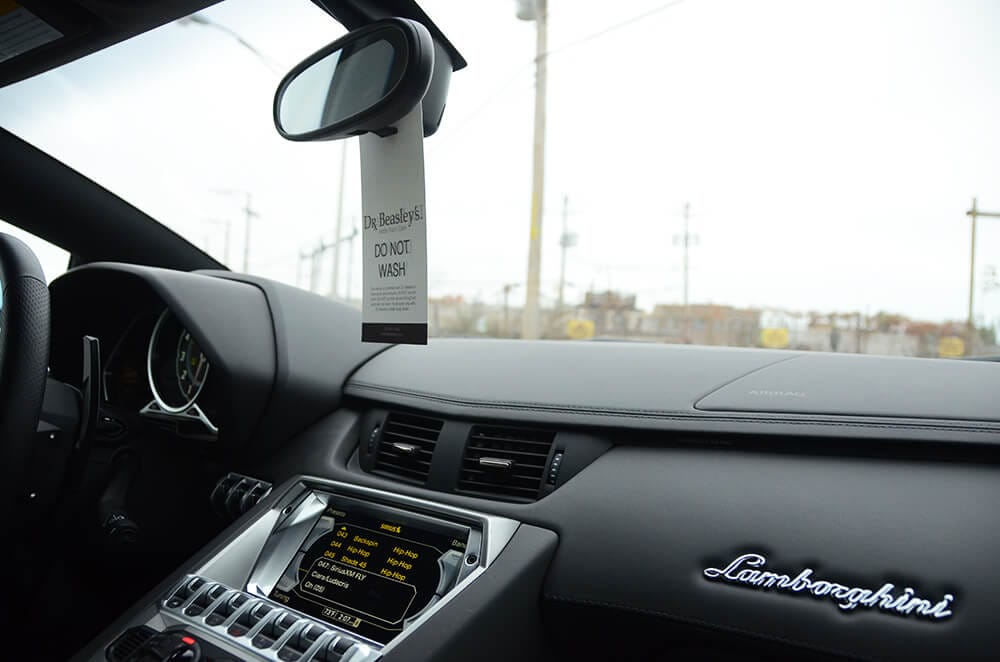
A modern vehicle interior can contain polyurethane-coated leather, synthetic leather, vinyl, soft-touch polymers, hard plastics, rubber, textiles, adhesives, coatings, displays, decorative films and natural materials. Each reacts differently to sunlight, heat, moisture and oxidation. And unlike exterior paint, some interior surfaces can spend years sitting in essentially the same position relative to the sun.
The dashboard is the obvious example. Research cited by Arizona State University researchers found that dashboards in parked vehicles can approach 160°F after about an hour in the sun under severe conditions.[7]
Now UV exposure isn’t acting alone — it’s combined with extreme heat, day after day, summer after summer. That can accelerate changes in polymeric materials and contribute to fading, hardening, discoloration, cracking and other forms of deterioration.
Why Interior Protection Is Different
You wouldn’t necessarily want to put an exterior ceramic coating on a dashboard or leather seat. Different surfaces require different coating characteristics.
Paint needs to preserve its intended finish, whether gloss, satin or matte, while resisting chemical and environmental degradation. Leather needs flexibility and an appropriate tactile feel. Interior plastics should retain their original appearance without becoming greasy or unnaturally glossy. Displays and touchscreens require optical clarity and compatibility with specialized surface treatments.
The underlying principle, however, remains similar: clean the surface properly, then establish a thin protective interface engineered for the material underneath it.
For interiors, that protective layer may help reduce staining, contamination and oxidation while making routine cleaning easier. If the formulation incorporates appropriate UV-stabilizing chemistry, it may also contribute directly to light stability. “Contains ceramic technology” by itself doesn’t tell you enough.
What About Leather?
Leather presents an especially interesting case because much of the leather in modern vehicles isn’t exposed leather in the traditional sense. Many automotive leathers have a pigmented and polymeric protective finish over the hide, which means you’re frequently maintaining the coating on the leather as much as the leather underneath it.
Sunlight and heat can affect those surface coatings. So can body oils, perspiration, sunscreen, dyes from clothing, cleaners and repeated abrasion from entering and exiting the vehicle.
A modern leather protection product therefore doesn’t need to soak deeply into the hide to be useful. Its job may instead be to protect the finished surface. Leather Lock and Leather Lock Pro, for example, are both engineered with UV-interacting nanoparticles built around that principle — Leather Lock in a water-based formulation, Leather Lock Pro in a solvent-based one, depending on the application. That’s a major shift from the old idea that every piece of automotive leather needs to be constantly “fed” with oils and conditioners.
Exterior Trim Tells the Story in Plain Sight
If you want to see weathering, look at neglected black exterior plastic. Over time, rich black trim can become gray, chalky and uneven.
People often try to solve the problem after the fact with a dressing that temporarily darkens the plastic. It looks better — until the dressing washes away and the gray returns. That’s cosmetic restoration, not necessarily long-term preservation.
A more durable coating approach tries to protect the substrate before severe deterioration occurs, using a bonded film designed to withstand washing and environmental exposure. Trim Coat Pro, for instance, builds UV-absorbing and light-stabilizing ingredients directly into that bonded film rather than relying on the film’s durability alone. That’s an important change in philosophy: don’t wait for the surface to fail and then make it look better. Slow the deterioration in the first place.
Ceramic Coatings Aren’t Force Fields
This needs to be said because the detailing industry sometimes oversells coatings.
No coating makes a vehicle immune to the sun. A coated vehicle parked outdoors in Arizona every day experiences a radically different environment from a coated vehicle stored in a climate-controlled garage. UV exposure is cumulative, and so are the other variables: temperature, exposure time, geography, the substrate, and the coating’s own formulation.
Even sophisticated UV stabilization systems used in industrial polymers and automotive coatings eventually have to contend with years of exposure.[1][3]
Ceramic technology doesn’t repeal chemistry. What it can do is change the rate at which deterioration occurs. And in preservation, slowing deterioration is the entire game.
The Best UV Strategy Isn’t One Product
If your objective is maximum vehicle preservation, don’t think in terms of finding one miracle bottle. Think in terms of layers of defense.
Park in a garage when possible. Use shade when practical — a quality windshield shade can dramatically reduce the solar load on interior surfaces. Window glass and films can provide additional UV management depending on their construction. Keep surfaces clean, because contamination can introduce additional chemical stresses. Protect paint, exterior plastics, rubber, leather, vinyl and interior plastics with products specifically designed for those substrates. And inspect them periodically — protection should be maintained before visible failure occurs, not after.
So, Does Ceramic Technology Really Protect Against UV?
Here’s the most accurate answer: it can, but not simply because it’s ceramic.
A ceramic coating’s primary advantage is its ability to form a much more durable protective film than traditional waxes and many conventional dressings. That film can help the underlying surface resist environmental and oxidative degradation. If the coating has also been specifically engineered with UV absorbers, stabilizers or UV-interacting nanoparticles, it can provide another mechanism of protection against solar radiation.
But those are formulation decisions. There is no universal rule that says every product labeled “ceramic” provides the same UV performance.
And that’s exactly why the evolution of automotive protection is so interesting. We’ve moved beyond simply spreading a temporary layer of wax over a surface. We’re increasingly able to engineer extremely thin protective films around the requirements of the substrate itself.
Paint. Plastic. Trim. Leather. Vinyl. Glass. Different materials. Different chemistry. Different vulnerabilities.
| Surface | Primary Concerns | Protection Must Preserve | Product |
|---|---|---|---|
| Paint | Oxidation, contamination, chemical exposure and weathering | Gloss, matte or satin appearance | Nano Resin |
| Dashboard and interior plastics | Heat, UV exposure, discoloration and staining | Original color and low-gloss appearance | Dash Pro |
| Exterior trim | Fading, chalking, oxidation and repeated washing | Dark, natural-looking finish | Trim Coat Pro |
| Leather and vinyl | UV exposure, abrasion, oils, dye transfer and staining | Flexibility, appearance and tactile feel | Leather Lock or Leather Lock Pro |
The objective, however, remains the same: slow down what time and the environment are trying to do to the vehicle.
That’s what modern vehicle preservation is really about. Not making a surface indestructible. Making it last longer.
If you’re putting that layered approach into practice, each surface calls for its own formulation: Nano Resin for paint, Dash Pro for the dashboard and interior plastics, Trim Coat Pro for exterior trim, and Leather Lock or Leather Lock Pro for leather and vinyl — each built with UV-absorbing or UV-interacting chemistry engineered for that specific substrate, not a single all-purpose bottle.
Footnotes
[1] Nichols, M. E., et al. Research into the long-term weathering behavior of automotive clear coats has demonstrated the important role of light-stabilization chemistry, particularly hindered amine light stabilizers (HALS), in slowing photooxidation and embrittlement. Polymer Degradation and Stability, Vol. 81, Issue 1, 2003.
[2] Pfaendner, R. “A brief history of plastic additives. Part 2: UV/light stabilizers.” Polymer Degradation and Stability, 2026. The review discusses the development and use of UV absorbers including benzophenones, benzotriazoles and hydroxyphenyl triazines, as well as HALS technology.
[3] Gerlock, J. L., et al. “Determination of ultraviolet light absorber longevity and distribution in automotive paint systems using ultraviolet micro-spectroscopy.” Polymer Degradation and Stability, Vol. 72, Issue 1, 2001, pp. 89–97. The researchers examined UV absorber concentration and loss within intact automotive paint systems during weathering.
[4] Research into the loss rate of UV absorbers in automotive coatings found that UVA loss during weathering is nonlinear and can also be influenced by film thickness, illustrating why long-term UV stabilization is more complicated than simply adding an absorber to a coating. Polymer Degradation and Stability, Vol. 61, Issue 1, 1998, pp. 151–159.
[5] Silica-based materials can be engineered for optical applications across portions of the ultraviolet spectrum; SiO₂ has, for example, been investigated as an optical coating for UV detector systems. This illustrates why the presence of SiO₂ alone should not be equated with UV blocking. Hamden, E. T., et al., “UV anti-reflection coatings for use in silicon detector design,” 2011.
[6] Amaral, S. P., Grosche, L. C., and Sousa, J. P. S. “Synergistic UV protection: Hybrid TiO₂@SiO₂/UVabs nanoparticles with augmented UV-shielding efficiency for the development of durable protective coatings.” Progress in Organic Coatings, 2025. The work demonstrates how nanoscale hybrid systems can combine UV absorption and scattering while eliminating TiO₂’s photocatalytic activity, producing more durable UV-shielding behavior.
[7] Vehicle interiors experience both solar radiation and substantial thermal loading. Research from Arizona State University and UC San Diego on parked-vehicle temperatures found dashboard temperatures averaging 157°F and approaching 160°F after about one hour under hot, sunny conditions, illustrating the severe environment faced by interior materials.
Questions? Comments?
Email Us